
Make.com vs n8n vs Zapier for Solo Creators (2026): How to Pick the Right Automation Platform in 30 Minutes
You’ve probably watched ten hours of YouTube comparisons and you’re still no closer to picking. Each video shows you a different feature matrix. Each reviewer has a different favorite. The “winner” changes depending on whose affiliate link you clicked. This Make.com vs n8n vs Zapier comparison is built for solo creators, not enterprise teams: the four dimensions that decide it, and the cost math most reviewers skip.
Here’s the problem with most of those videos: they compare features, not situations. Solo creators don’t need 8,000 integrations. You need maybe twelve. You don’t need enterprise SSO or a team collaboration suite. You need one platform that handles your repurposing pipeline without surprising you with a $400 overage bill on a Tuesday.
This post does something different. It gives you a verdict in the second section, then shows the work behind it: the cost math at your actual usage, the AI integration depth that matters for Claude-powered workflows, and the error recovery story when something breaks at 6am. By the end you’ll know which of these three is right for you, and why.
Five minutes of reading. No fence-sitting “it depends” at the end. If you haven’t yet decided what to automate, start with how to repurpose content with AI and come back here when you’re ready to pick a platform.
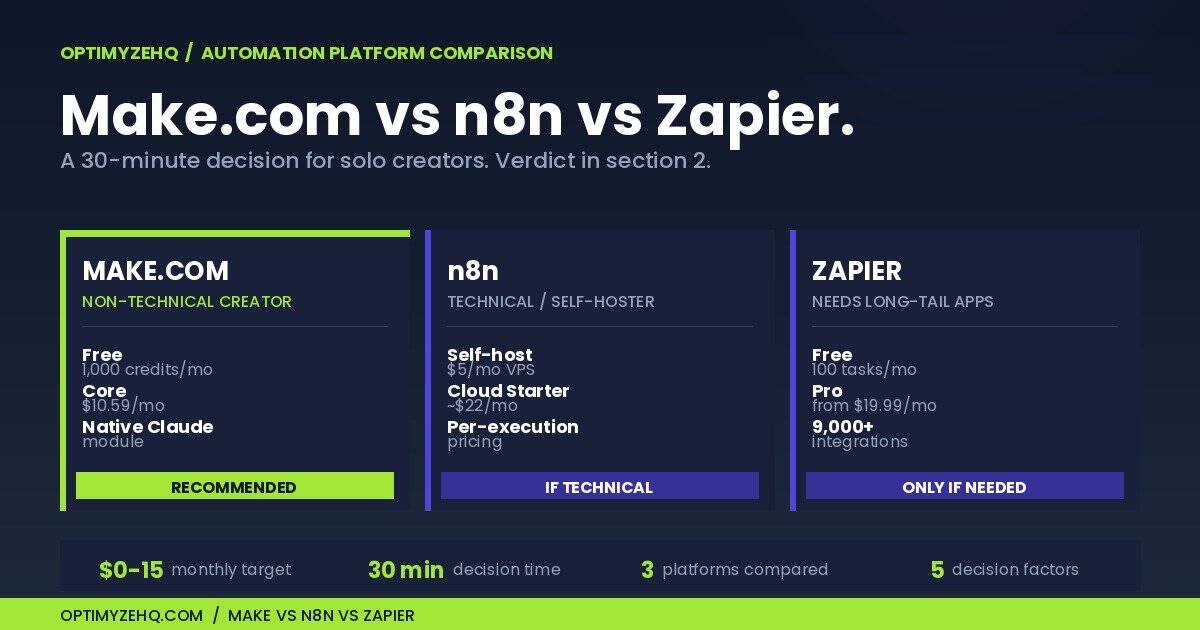
Make.com vs n8n vs Zapier: the verdict, before the work
For the typical solo creator publishing 2–5 pieces of content per week and running an AI repurposing pipeline (one input, multiple outputs), Make.com wins on cost, time-to-first-working-scenario, and AI integration depth. Its free tier handles roughly 75 runs per month of a Notion > Claude > 3-output pipeline. The Core plan at $9/month annual ($10.59 monthly) covers anything realistic. Make’s native Anthropic Claude module supports the full 4.x family, and as of March 24, 2026 Make is a built-in connector inside Claude itself, meaning Claude Desktop can run your Make scenarios directly via OAuth, no token-pasting required.
That said, two profiles should pick something else.
If you’re technical, comfortable with Docker and a $5/month VPS, and you want the lowest possible long-term cost, self-hosted n8n is the right answer. One execution per workflow run regardless of step count, unlimited executions on a Hetzner box, and native AI agent capabilities that go deeper than anything Make or Zapier ship.
If you need an integration only Zapier has (and you should check before deciding), Zapier is the only path. The catalog gap is real (Zapier claims 9,000+ apps; Make is at 3,000+; n8n is at ~1,000+). For long-tail SaaS, legacy tools, or niche regional apps, Zapier sometimes wins by default.
That’s the verdict. The rest of this post earns it.
Who this is for and what this isn’t
This is written for solo creators, freelancers, and indie operators running their own content or service business. You probably spend 5–15 hours a week on content production. You’re using or seriously evaluating Claude or another LLM. You want to spend less time copying drafts between tools and more time on the work that earns money.
This isn’t an enterprise comparison. If you’re staffing a 50-person agency or evaluating Workato, Tray.ai, or Boomi, this post is the wrong document. We’re not covering on-prem deployment, audit logs, or SSO governance. We’re not benchmarking integration counts past ~1,000 because no solo creator uses more than two dozen apps.
We’re also not teaching the basics of any platform. If you want to see exactly how a Make.com pipeline works step by step, read how to build a no-code AI content pipeline with Make.com and Claude. That’s the canonical walkthrough this post is pricing across all three platforms.
The four dimensions that actually matter (and the six that don’t)
Every comparison post leads with a feature matrix. Most of those features don’t change your decision. Here are the four that do.
Cost at your actual usage level, not the max plan. Pricing pages show you ceilings. What you care about is your floor: at 30 or 100 or 300 runs per month, what do you actually pay? Most “Zapier vs Make” posts compare the $19.99/mo entry tier to Make’s $10.59/mo Core, ignoring that 5-step Zaps blow through 750 tasks fast and force you to upgrade.
Time to first working scenario. Measured in minutes from signup, not “how easy is the documentation.” A solo creator with two hours on a Saturday afternoon has a different requirement than an agency onboarding clients.
AI and Claude integration depth. Native module versus HTTP fallback is not a cosmetic difference. Native modules handle credential vaulting, OAuth refresh, typed model dropdowns, automatic rate-limit retries, and surfaced cache_control toggles for Anthropic prompt caching. HTTP nodes work fine but you hand-roll the rest.
Error recovery when something breaks at 6am. Your pipeline runs unattended. When a credential expires or LinkedIn rate-limits you, what does the platform do? Email you? Retry? Pause silently and lose data? This is the dimension nobody tests until it bites them. One reliability flag worth knowing: n8n’s official status page shows “no incidents” during stretches when third-party monitors detect real outages, while Zapier’s status page logs ~49 incidents in a typical 90-day window. Don’t rely on either platform’s self-reported uptime alone, wire up your own webhook-based health check if reliability matters.
Here’s what doesn’t matter for solo creators: integration count past 500 (you’ll never use most of them); enterprise SSO; team collaboration features; on-prem deployment; fancy UI animation; and, controversially, AI agent capabilities. That last one is the one most reviewers get wrong. For a stable rule-based content repurposing recipe (“when X drops in Notion, run prompt Y, post to LinkedIn/X/email”), you do not need an autonomous agent. You need a reliable scheduler with a good Claude module. All three platforms are pushing AI agents hard in their 2026 marketing because that’s where the venture money is, but for the workflow most creators actually run, agentic capabilities are a different shape of problem.
Make.com, honest assessment
When Make wins. Make’s free tier is genuinely usable. 1,000 credits per month, two active scenarios, 15-minute polling minimum. For the canonical 5-step repurposing pipeline (1 trigger + 4 actions ~ 5 credits per run with your own Anthropic API key), the free tier covers roughly 200 runs per month. Most solo creators never need to upgrade.
When you do upgrade, Core at $9/month annual ($10.59 monthly) gives you 10,000 credits, unlimited active scenarios, and one-minute polling. That’s enough for any solo creator running 1–5 pipelines.
The native Anthropic Claude module is marked Verified, supports 16 actions including Create a Prompt, Upload File, Create Skill, Make an API Call, and lets you select Sonnet 4.6, Opus 4.7, Haiku 4.5, or earlier 4.x models from a dropdown. Connection is OAuth or API key. Behind the scenes, Make can either pass your tokens through to your own Anthropic key (1 credit per call regardless of payload, best for high volume) or use Make’s built-in AI provider where credits scale with token consumption.
The newest superpower: on March 24, 2026, Make became a built-in connector inside Claude itself. You add Make as a connector at claude.ai/settings/connectors, complete OAuth, and Claude Desktop can now invoke your Make scenarios directly. No more pasting MCP server URLs. The flow works in both directions. Claude triggers Make scenarios; Make’s Anthropic module continues to call Claude via API. For anyone living inside Claude as their primary work surface, this is the single biggest 2026 unlock.
When Make loses. Make’s catalog is real but smaller than Zapier’s. About 3,000 verified integrations versus Zapier’s 9,000+. If you use a niche tool, check first.
The credit system rewards careful design but punishes spaghetti. Routers, iterators, and aggregators each consume credits per item processed. A poorly designed scenario that fan-outs over a 50-row CSV can burn 250 credits when you expected 10. Make also charges a 25% premium on extra credits as of November 6, 2025, whether you buy them manually or auto-purchase them. Scenarios shut off after consecutive 5xx errors and require manual queue restarts.
Code nodes are not available outside Enterprise. If you want to write a JavaScript transform inline, you’ll use the Tools module’s “Set Variable” with expression syntax, which is more limited than n8n’s full Code node.
n8n, honest assessment
When n8n wins. Pricing is the headline. n8n charges per workflow execution, not per step. One run of the 5-step repurposing pipeline = 1 execution. The same workload on Zapier = 4 tasks. At 100 runs per month, that’s 100 executions on n8n vs 400 tasks on Zapier, which already exceeds Zapier’s $19.99/mo Starter 750-task tier the moment you add a second pipeline.
Self-hosting tilts the math further. The Community Edition is free under the Sustainable Use License, runs on a $5/month Hetzner VPS, and gives you unlimited executions, unlimited active workflows (the limit was removed across all plans on August 7, 2025), unlimited users, and the full feature set including code nodes. For technical creators, this is functionally free automation forever. Cloud Starter at €20/month annual (~$22) is the path if you don’t want to manage a server.
n8n’s AI capabilities are deeper than Make’s or Zapier’s. Native AI Agent nodes, native MCP support both directions (n8n acts as MCP server to Claude Desktop, and as MCP client when calling other servers), human-in-the-loop approval gates, and a Guardrails node that detects PII and prompt injection. The October 2025 Series C, $180 million at a $2.5 billion valuation led by Accel with NVIDIA’s NVentures participating, was a vote of confidence that n8n is the agentic-automation infrastructure layer that survives.
When n8n loses. The technical setup tax is real. Self-hosting means Docker, environment variables, SSL, backups, version updates, and the responsibility to actually monitor your own instance. Most solo creators skip this even though they could handle it. n8n Cloud removes the tax but doubles the price relative to Make Core.
Integration breadth is the smallest of the three. n8n claims “1,000+ integrations” between native nodes and verified community nodes; the more conservative count of well-maintained native nodes is closer to 500. For long-tail apps you’ll be using the HTTP Request node and writing your own auth.
The Sustainable Use License has a “no hosting-as-a-paid-service” carve-out that confuses some creators. To be clear: you can self-host n8n for your own business use forever, free, with no asterisk. You can’t resell n8n hosting to your clients without a commercial license.
Zapier, honest assessment
When Zapier wins. The catalog. Zapier claims 9,000+ apps, the largest in the category, and the long-tail integrations are the differentiator. If you use a niche CRM, a regional payments processor, or a vertical SaaS tool, Zapier is often the only platform with a native connector.
Setup speed is the other genuine win. Zapier Copilot generates working Zaps from a natural-language description (“when a new row hits Google Sheets, post to LinkedIn”) and the Zap editor is the most polished in the category. For non-technical creators with two hours and zero patience for Docker, Zapier gets you to a working automation faster than anything else.
The September 2025 unified-plan announcement bundled Tables, Forms, Interfaces, Zapier MCP, and Copilot into Free, Pro, and Team. These are features that previously cost extra. Zapier MCP exposes 9,000+ apps to Claude as a tool plane (each MCP call costs 2 tasks from your Zap quota). On Free, MCP is included; on paid plans, you get unlimited use within your task ceiling.
Trigger steps don’t count as tasks. Filter, Formatter, Paths, Delay, Looping, Sub-Zap, Digest, Storage, Tables, and Forms steps don’t count. Polling checks don’t count (“Zapier never charges you a task to check for new data”). Only successful Action steps and MCP tool calls consume tasks.
When Zapier loses. Per-task pricing punishes the workflows solo creators actually run. The repurposing pipeline (1 trigger + 4 publishing actions = 4 tasks per run) eats Free’s 100-task allotment in 25 runs. Free is also limited to 2-step Zaps, which makes the canonical 5-step pipeline impossible on the free tier. Starter is $19.99/month annual for 750 tasks (~187 runs of this workflow), which forces the upgrade to Professional at $49/month annual for 2,000 tasks once you cross that threshold.
The overage policy is unforgiving. Tasks above your plan are billed at 1.25x the per-task rate, and Zaps pause when you hit 3x your subscription’s task limit. The 1.4 Trustpilot rating across hundreds of reviews skews heavily toward billing complaints: surprise auto-renewals, runaway loops burning thousands of tasks overnight, and slow response times on dispute tickets. (For balance: G2 has Zapier at 4.5/5 across 1,830 reviews. The Trustpilot skew reflects billing rather than product, but it’s a real pattern.)
Zapier’s listed Anthropic integration page still cites “Claude 3.5 Sonnet, Claude 3 Opus, Claude 3 Haiku” as supported models, copy that’s stale relative to the May 2026 catalog. The model selector inside the Zap editor likely lists current models, but the marketing copy hasn’t kept pace.
The cost comparison nobody shows correctly
Most “Make vs n8n vs Zapier” posts compare entry-tier prices side by side and call it a day. That’s not how solo creators actually pay for these tools. The right question is: at your monthly run count, with your workflow complexity, what’s the bill?
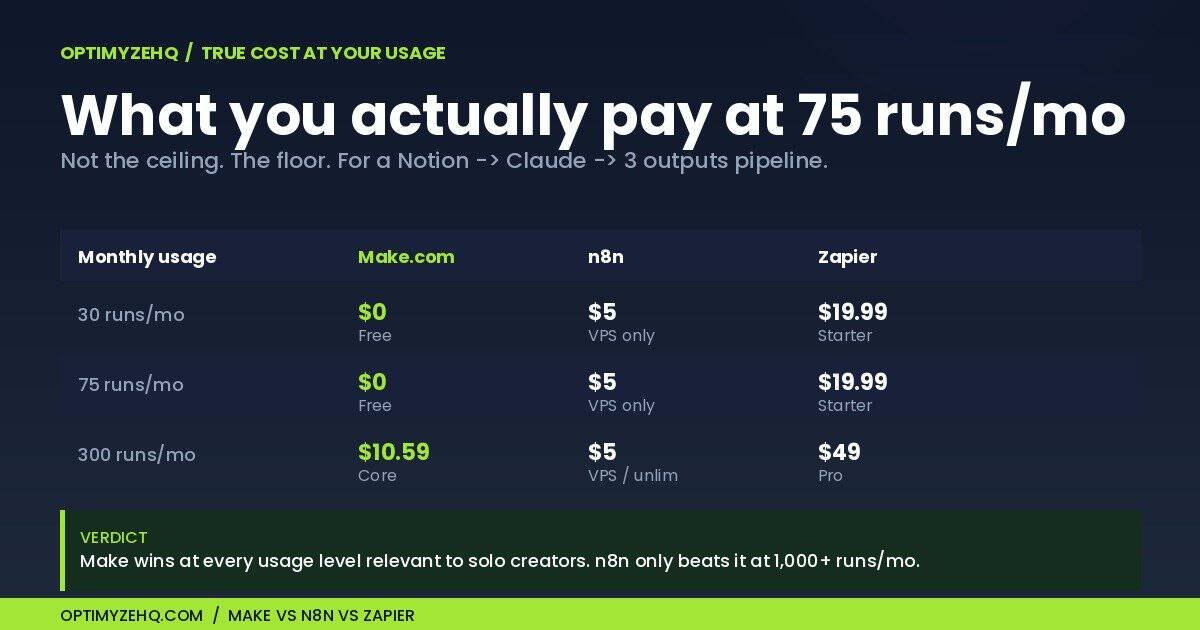
Here’s the apples-to-apples math for the canonical pipeline, the same one walked through in how to build a no-code AI content pipeline. One Notion trigger, one Claude Sonnet 4.6 transformation, three publishing actions (LinkedIn, X, Gmail draft). Five steps total per run. Priced across three usage levels.
| Workload | Make.com | n8n self-host | n8n Cloud Starter | Zapier Pro |
|---|---|---|---|---|
| 30 runs/mo | $0 (Free, 150 credits used) | $5 (VPS) | ~$22 (€20 annual) | $19.99 (750-task tier) |
| 100 runs/mo | $0 (Free, 500 credits used) | $5 | ~$22 | $19.99 |
| 300 runs/mo | ~$10.59 (Core, 1,500 credits used) | $5 | ~$22 | ~$49 Pro (2,000 tasks) |
Three things to notice. First, Make’s free tier carries you a long way. 1,000 credits comfortably covers 200 runs per month if you bring your own Anthropic API key (recommended for cost control). Second, self-hosted n8n is the cheapest at every volume. The trade-off is the Docker setup. Third, Zapier’s per-task model crosses the $49 line at 300 runs because 4 tasks × 300 runs = 1,200 tasks, exceeding the 750-task Starter tier and forcing the upgrade to Professional (2,000 tasks).
Anthropic API token costs are separate from platform fees. For the same workload assuming ~2,000 input + ~1,500 output tokens per run on Claude Sonnet 4.6 ($3 input / $15 output per 1M tokens), expect roughly $0.86/month at 30 runs, $2.85/month at 100 runs, $8.55/month at 300 runs. Anthropic prompt caching cuts that by 75–90% after the first cache write: cache writes cost 1.25x base input and cache reads cost 0.1x base input. For a stable system prompt, the math gets very cheap, very fast.
Hidden costs to watch on each platform. Make charges a 25% premium on extra credits past your plan allotment. n8n self-hosting requires you to handle backups, SSL, and version updates yourself (real time cost, even if not dollar cost). Zapier’s overage at 1.25x the base task rate stacks on top of usage you didn’t intend, and the auto-replay system can burn tasks overnight if a step keeps failing. None of these is a dealbreaker; all of them are reasons to monitor usage in the first month.
Five decision factors that should make your choice obvious
You don’t need a feature matrix. You need to find yourself in one of these five rows.
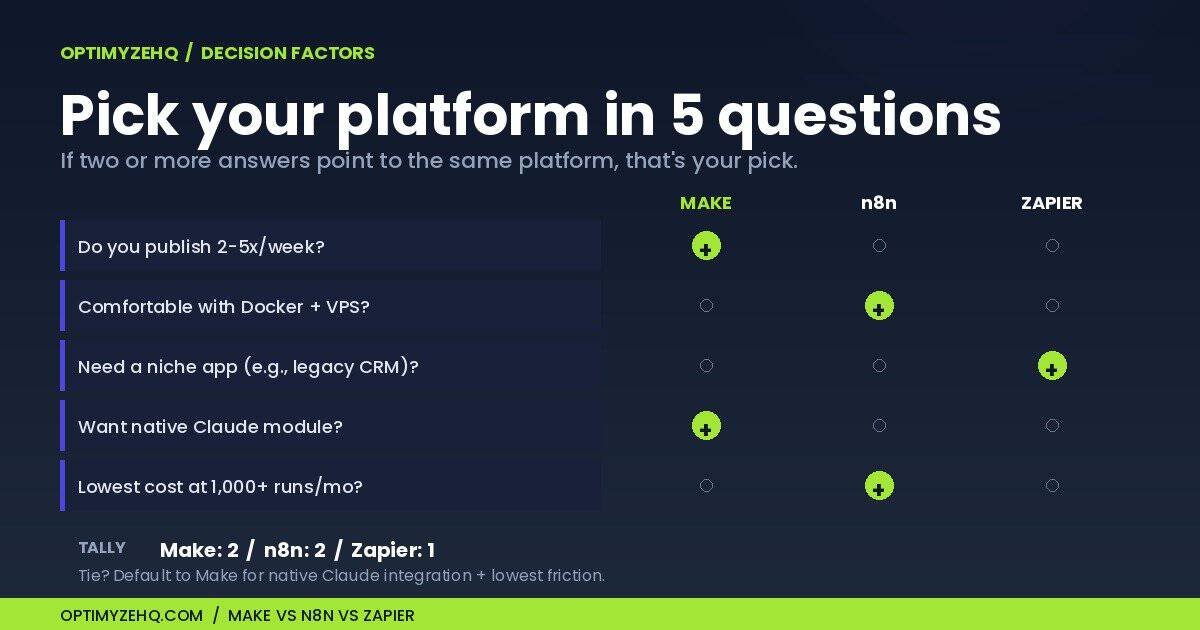
“I want to start automating today and I’m not technical.” Make.com. Free tier handles your first hundred runs while you learn the platform. Native Claude module means no API plumbing. The Make-as-Claude-connector path means you can drive your scenarios from Claude Desktop conversationally. Setup time is roughly 90 minutes from signup to first working pipeline.
“I want the lowest possible long-term cost and I can self-host.” n8n Community Edition. $5/month for a Hetzner VPS, unlimited executions forever, code nodes on every plan, native MCP both directions. Setup time is roughly 3 hours including Docker, SSL, and your first workflow. Worth it if you’ll be running automation for years.
“I need an app the others don’t connect to.” Zapier, but verify first. Use Zapier’s app directory search before deciding. If your obscure app is on Make’s 3,000-app catalog or accessible via n8n’s HTTP node with reasonable effort, you don’t need Zapier and you’ll save money on every other workflow.
“I want the deepest AI agent capabilities.” n8n. Native AI Agent nodes, MCP support both directions, human-in-the-loop approval gates, Guardrails node, and the Series C money is going into making this the agentic-automation infrastructure layer. Make and Zapier ship agent products too (Zapier Agents at agents.zapier.com, Make’s Maia), but they’re feature additions on top of rule-based platforms. n8n is being designed agent-first.
“I’m building a real business and I need predictable bills.” Make.com Core at $9/month annual ($10.59 monthly). Credits don’t expire mid-cycle. Free tier serves as a cushion during slow months. The 25% premium on extras keeps you honest about scenario design without surprising you with 3x overage charges. The Creator Content Engine (our $97 product) is built on Make for exactly this reason: when we tested all three platforms across the same workflow, Make was the only one that gave us a flat, predictable bill that didn’t punish growth.
If you’re between two of these profiles, default to Make. It’s the one that’s hardest to regret.
What about Pipedream, Activepieces, Pabbly, Lindy, and the new entrants?
Five other platforms come up frequently. Quick honest reads on each.
Pipedream. Workday acquired Pipedream and the deal closed in Q4 FY26 (confirmed in Workday’s February 24, 2026 earnings release; specific close date not published). The product is alive: pipedream.com is up, signups work, the docs still show Free / Basic $29 / Advanced $79 / Business. But Workday’s stated direction is to fold Pipedream into its enterprise AI agent stack alongside Sana and Flowise, building around its 11,000+ enterprise customers. Pipedream’s own blog has been silent since the November 19, 2025 acquisition announcement, six months with no roadmap update or customer letter as of May 2026. Honest read: alive, but no longer prioritized for your use case. Don’t migrate to Pipedream in 2026 unless you’re already deep in.
Activepieces. MIT-licensed open source. Self-hosted Community Edition is free with unlimited everything. Cloud pricing changed in late 2025 to $5 per active flow per month with unlimited runs, with the first 10 flows free. The MCP toolkit is the strongest hook: every Activepieces piece is exposed as an MCP server usable from Claude Desktop, Cursor, and Windsurf. The integration catalog is in transition: somewhere between 280 and 700 pieces, with about 60% community-contributed. Real winner if you want flat per-flow pricing and the integration set covers you.
Pabbly Connect. Lifetime deal pricing repriced upward in early 2026: Standard $349 (3,000 tasks/month, 10 workflows, 2-step only), Ultimate $799 (10,000 tasks/month, unlimited multi-step workflows), Ultimate Plus $1,298 (20,000 tasks/month). Older blogs citing $249/$499/$699 are stale. Pabbly is a niche pick if you genuinely hate recurring fees and your stack is stable enough that “lifetime” isn’t a misnomer. The free tier is unusually generous (100 tasks/month with multi-step on free). Common complaints include account-email inflexibility, no live chat support, and a low complexity ceiling on logic and error handling.
Lindy AI. Repositioned in 2026 as a personal AI assistant: inbox triage, calendar, meeting prep, SDR outreach. Plus tier $49.99/month, Pro $99.99/month. No free self-serve tier; entry is a 7-day Plus trial. Overkill for stable rule-based content repurposing. Lindy’s credit-per-action model and AI-judgment-first design make deterministic cron-like flows expensive and over-instrumented. Use Lindy when you need email triage or autonomous sales outreach, not when you have a settled “Notion > Claude > 3 channels” recipe.
Two new 2026 entrants worth knowing. Gumloop closed a $50M Series B led by Benchmark in March 2026; Solo tier is $37/month with 10,000 credits (and AI nodes drop from 20 to 1 credit per call if you bring your own API key), genuinely solo-relevant for AI-heavy batch workflows. Sim (sim.ai) is YC-backed, open-source, native MCP, ~1,000 integrations, marketed as the “Zapier of agent building,” worth watching if you want an open-source agent-first platform that doesn’t require self-hosting expertise.
FAQ
What if I pick wrong? How hard is migration later?
The workflow logic transfers; the credentials don’t. None of these three platforms can import another’s exported workflow natively. Community-built converters exist for Make > n8n and Zapier > n8n, and AI-assisted manual conversion via Claude works for about 70% of cases (it breaks on iterators, error handlers, and proprietary expression syntax). The real switching cost is OAuth re-authentication: you’ll re-authorize every connected app on the new platform, which can be a half-day’s work if you have 20+ integrations. Plan for one weekend if you ever need to move.
Why doesn’t Make’s free tier last forever for everyone?
Three reasons. You hit 1,000 credits per month if you cross ~200 runs of a 5-step pipeline (or ~75 runs if you use Make’s built-in AI provider instead of your own API key). You hit the 2-active-scenarios limit if you build more than two pipelines. You hit the 15-minute polling minimum if you need real-time triggers. Any of those three pushes you to Core at $10.59/month, which most solo creators don’t mind.
Are AI model fees included in the platform price?
No. All three platforms either pass through token costs to your own Anthropic key (the cheaper option, recommended) or front the connection and bill credits/tasks based on token consumption (more expensive, but no API key management). Make’s built-in AI provider charges roughly 7 extra credits per Sonnet 4.6 call for typical content workloads. n8n’s AI nodes always require your own API key. Zapier’s Claude integration uses your API key. Budget separately for token spend: for a 100-runs-per-month repurposing pipeline on Sonnet 4.6, that’s about $3/month on top of your platform fee.
How long until I’m productive on each platform?
Rough numbers from a non-technical creator with no prior automation experience. Zapier: 30 minutes to a working 2-step Zap with Copilot. Make.com: 90 minutes to a working 5-step scenario with the visual builder. n8n self-hosted: 3 hours including Docker, SSL, and the first workflow (longer if you’ve never used Docker). n8n Cloud: 60 minutes, comparable to Make once you skip the hosting setup. The gap closes after week one; all three have solid documentation now.
Does Anthropic’s MCP integration change the math?
Yes, but only marginally for most solo creators. The MCP layer means Claude Desktop can drive any of the three platforms as a tool plane: Make as a built-in connector, Zapier MCP exposing 9,000+ apps, n8n’s instance-level MCP server. Functionally, you can use Claude as the front-end AI client with any platform as the back-end action layer. This makes your platform choice more about cost, reliability, and integration depth than about AI features, because the AI layer is increasingly portable. The decision still comes down to the four dimensions in section four.
Bottom line
For most solo creators running an AI repurposing workflow in 2026, the right choice is Make.com: free tier carries you to first revenue, Core at $10.59/month covers anything realistic, and the native Claude integration plus the new built-in-Claude-connector status makes it the platform with the lowest friction between AI work and shipped output. Pick n8n self-hosted if you’re technical and want the cheapest possible long-term cost. Pick Zapier only if you specifically need an app the other two don’t connect to.
Whichever you pick, the actual leverage isn’t the platform. It’s having a designed pipeline that you trust enough to run unattended. If you want a working blueprint to start from, grab the free Creator’s AI Starter Kit: it’s the same workflow architecture we’re pricing across all three platforms in this post, ready to import and run.
Sources and further reading
- Make.com plans and pricing: make.com/en/pricing
- Make as built-in Claude connector announcement: help.make.com
- n8n plans and pricing: n8n.io/pricing
- n8n Series C announcement (Oct 9, 2025): blog.n8n.io/series-c
- n8n unlimited workflows update (Aug 7, 2025): blog.n8n.io
- Zapier plans and pricing: zapier.com/pricing
- Zapier MCP: zapier.com/mcp
- Workday acquires Pipedream (announced Nov 19, 2025; closed Q4 FY26): Workday Q4 FY26 earnings release
- Activepieces pricing: activepieces.com/pricing
- Pabbly Connect lifetime deals: buy.pabbly.com/connect-onetime
- Anthropic Claude API pricing: platform.claude.com/docs/about-claude/pricing
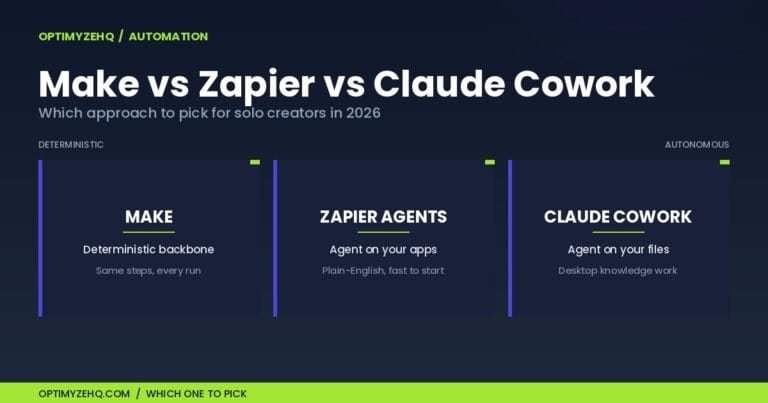
The 2026 update: automation has gone agentic since this comparison. See the successor, the Make vs Zapier vs Claude Cowork comparison, and a hands-on look at what Claude Cowork actually does.
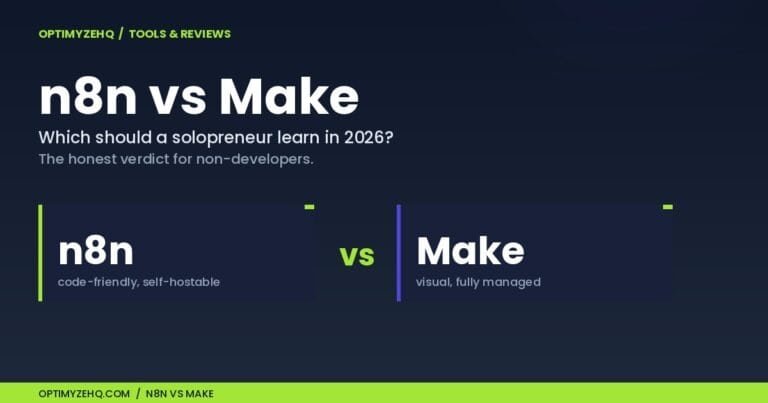
Down to two tools? If you have ruled out Zapier, the deeper n8n vs Make verdict walks the same build on each platform and recommends one by reader profile.