
How to Write a Cold Email With AI (That Doesn’t Read Like a Bot)
Here is the problem no one selling you a cold email tool will admit. AI did not make cold email work better. It made it work worse.
Two years ago, writing a real email to a stranger took effort, and effort was a filter. Now anyone can generate five hundred emails that each open with “I loved your recent post” before lunch. Buyers noticed. So did the inbox providers: Gmail, Yahoo, and Microsoft enforced bulk-sender rules in 2024 and 2025, and the Gmail sender guidelines now demand you stay under a 0.1% spam-complaint rate, with hard enforcement at 0.3%, which means a few annoyed recipients can quietly sink your whole domain. Generic mail gets filtered before a human ever sees it.
So the winning move is not more email. It is fewer, sharper, human-approved emails, built on a repeatable cold email framework where AI does the drafting and you do the thinking. The pattern across cold outreach data is consistent: smaller, tightly targeted sends outperform broad blasts, and the people most likely to reply to a solo operator, founders and owners of small and mid-sized companies, are exactly the ones a mass blast burns first. That constraint is the solo advantage. A sales team needs volume because nobody there has time to research every prospect; you need a handful of good clients, so you can afford the research they cannot.
This piece is about how to write a cold email with AI that a real person actually wants to answer, with Claude drafting and you editing. It is for freelancers and solo operators sending a handful of targeted emails a week to people they could genuinely help. If your plan is to blast a scraped list of ten thousand contacts, close this tab. Nothing here will help you, and nothing should.
What this is not
This is not a spam playbook. The whole method assumes low volume: a few emails a day, each one to a person you chose on purpose. Volume is the enemy here, not the goal. It is also not email marketing: newsletters, nurture sequences, and abandoned-cart flows are a different machine with different rules. This is one-to-one prospect outreach, one researched person at a time.
It is not automation that sends on its own. Claude drafts. You read every word and you press send. The moment a machine is emailing strangers unattended in your name, you have built a liability, not a pipeline.
And it is not the whole client-getting system. Finding the right people, scoring them, tracking who you contacted and routing them through follow-up is a separate machine. I wrote that one up in how to get clients with AI, which covers the four-layer pipeline end to end. This piece lives inside that pipeline at one specific spot: the message itself. Get the message wrong and the best-built pipeline in the world only delivers your mistake faster.
One more thing it is not: a trick. There is no subject line that rescues a bad fit. If you email someone you cannot actually help, the most polished email in the world earns you a polite no, or silence. The craft below only works after you have picked the right person.
The anatomy of a cold email that gets a reply
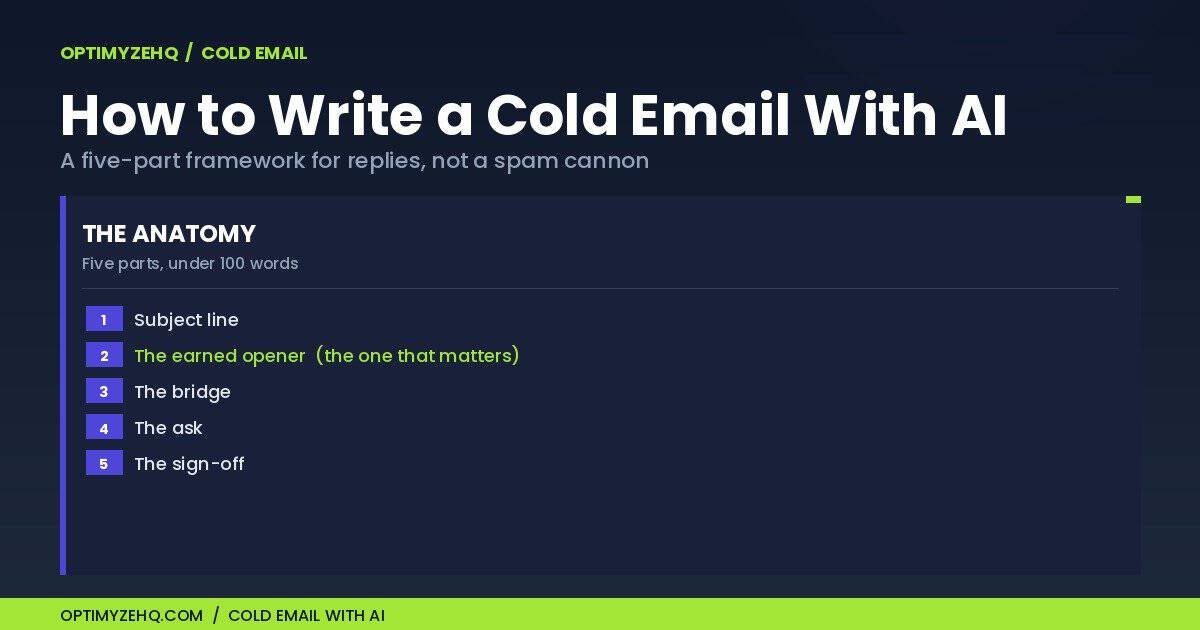
A cold email that works has five parts, and only five. Keep the whole thing under about 100 words. The best-performing cold emails run short and are built around a single ask, and long emails read as work the recipient did not agree to do.
1. The subject line
Three to five words that name something specific to them, never something about you. “Quick question” and “Following up” are invisible now; everyone uses them, so they read as mass mail. Reference their situation instead.
Weak: “Helping businesses grow.” Better: “Your March pricing page.” The second one could only have been written to one person, and that is the entire job of a subject line: prove, in five words, that this was not sent to a thousand people.
2. The earned opener
This is the line that decides everything, so it gets a name: the earned opener. It is one true, specific observation about the recipient that you could only make if you actually looked. Not flattery. Not “I love your work.” An observation.
“I noticed you added a second coaching tier but the checkout still routes both to the same intake form” is an earned opener. It proves you looked, it is useful on its own, and it sets up the reason you are writing. “I’ve been following your journey and I’m so inspired” is the opposite: it could be pasted into any inbox on earth, which is exactly how the reader will read it.
The earned opener is also the one part AI cannot manufacture for you, and the section below on where AI helps is mostly about protecting this line.
3. The bridge
One sentence connecting what you noticed to a problem you solve. The observation earns attention; the bridge gives it a point. “That split usually means people abandon at checkout, which is the kind of leak I fix for course creators” takes the specific thing you saw and turns it into a reason this email exists. No bridge, and you are a stranger making small talk. Too long a bridge, and you are pitching before you have earned it.
4. The ask
One small, low-friction next step. Not “hop on a 30-minute discovery call,” which asks a stranger to give you half an hour before you have proven anything. Ask for a reply, not a calendar block. “Worth a quick look? I can send you the two changes I’d make, no call needed” is a yes-or-no question a busy person can answer in one line. A single, clear call to action outperforms stacking several, so resist the urge to add “or book a call, or grab my lead magnet, or connect on LinkedIn.” The meeting is not this email’s job. The email earns a reply; the reply earns the call.
5. The sign-off
Your name, what you do in four words, and nothing else. No fake deadline, no “circling back Thursday,” no eight-line signature with three social icons and a quote. Manufactured urgency is the tell of someone who does this at scale, and you are trying to signal the opposite. And send as yourself: a solo operator writing as a made-up “team” or an invented assistant torches the exact credibility this method is built to earn.
Put together, the whole thing is roughly six lines. It reads like an email one person wrote to one other person, because that is what it is. Everything after this section is about using AI to produce that email faster without letting it strip out the one thing that makes it work.
Where AI helps, and the one thing it must never do
Claude is good at the parts of a cold email that are structural. It will hold the five-part shape, keep you under 100 words, generate two or three subject-line options to choose from, tighten a clumsy sentence, and, if you feed it a sample of your own writing, draft in something close to your voice rather than corporate default. Those are real time savers, and they are the boring parts you were going to get wrong when tired anyway.
There is exactly one thing it must never do: invent the personalization.
The earned opener has to come from you, because it has to be true. When you ask a model to “personalize this for Maya,” with nothing but her name, it does what it always does under pressure. It guesses. It produces “I’ve been really impressed by your recent growth,” which is not an observation, it is a plausible-sounding blank. The recipient has read that exact sentence forty times this month, and every one of them was a machine. A fabricated compliment is worse than no opener at all, because it actively confirms you did not look.
So the division of labor is fixed. You do the looking and you write the one true sentence. Claude does the structure, the trimming, and the variants. If you find yourself asking the model to come up with the reason the email is relevant, stop. That is the part that cannot be automated, and it is also the part that is the whole point.
A starter prompt you can use today
Here is an AI cold email prompt that puts all of this to work. Write your observation first, in your own words, because it enters the prompt as a locked fact Claude is not allowed to change. Then paste the prompt into Claude, fill in the bracketed facts, and it will draft the email inside the anatomy above without wandering off.
You are helping me write one short cold email to a specific person I
have researched. I will give you the facts. Do not invent any detail
about them.

Facts:
- Who they are and what they do: [name, role, business]
- The specific thing I noticed, in my words: [the true observation]
- The problem that observation points to: [problem]
- What I do and who I do it for: [your offer, one line]
- The one small ask: [a reply-level ask, no call]

Write the email in five parts, under 100 words total:
1. Subject: 3 to 5 words about their situation, not me.
2. Opener: restate my observation in one natural sentence. Use only
   what I gave you. If a detail is missing, leave it out. Do not guess.
3. Bridge: one sentence linking the observation to the problem I solve.
4. Ask: one low-friction, reply-level question. No calendar links.
5. Sign-off: my name and what I do, in four words.

Rules: plain text, no "I hope this finds you well," no flattery, no
urgency, one call to action only, no em dashes. Give me three subject
options and two body versions.

My name and one-line description: [name, what you do]
That is the whole free method. It removes the blank page and the structural fiddling. It does not remove the judgment, which is yours: picking the right person, writing the true observation, and deciding the draft is good enough to send.
The human pass: making it not sound like AI
Every AI draft ships with tells, and buyers have learned all of them. Before you send, run a fast edit pass and cut the following on sight: “I hope this finds you well,” “I wanted to reach out,” “I came across your profile,” any sentence that could open any email, and the corporate verbs that creep in even when you asked for plain text. Watch for the em-dash pileup too; models love them, and a stranger’s email stacked with them reads as generated.
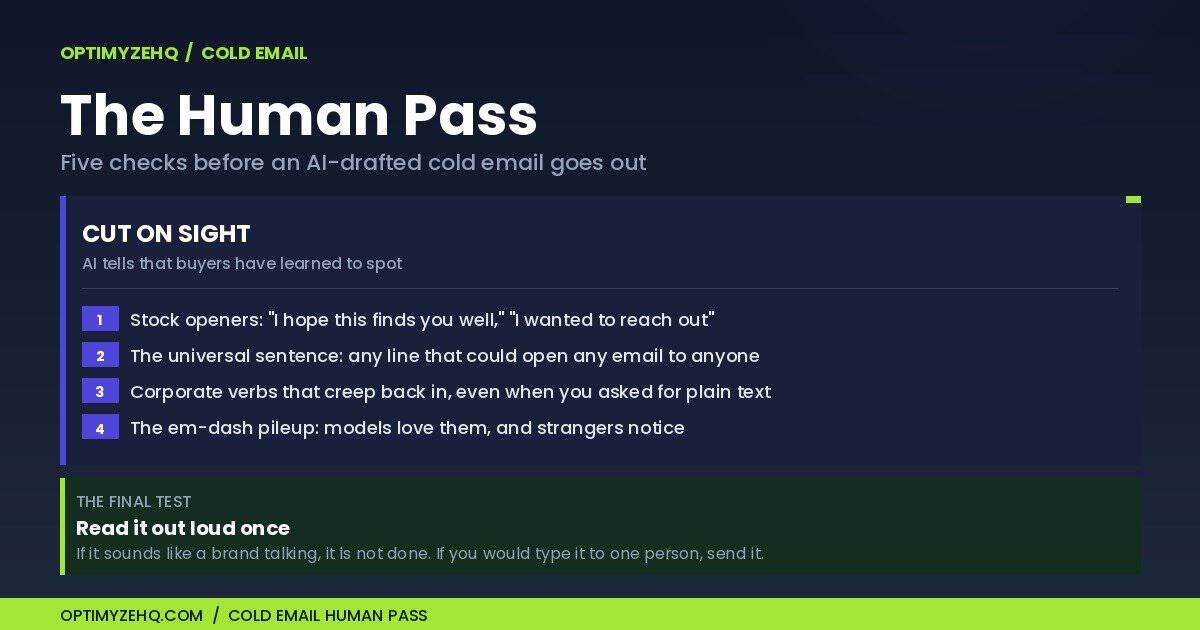
Read the final version out loud once. If it sounds like something you would actually type to one person, send it. If it sounds like a brand talking, it is not done. This is also where a stored voice profile pays off: if you have taught Claude how you write, the drafts arrive most of the way there instead of needing a rescue. That setup is its own thirty-minute job, and I walk through it in the Voice DNA framework.
Worked example: one email, first draft to sent
Say I sell email and funnel help to course creators, and I have found Maya, who recently launched a second, higher-priced coaching tier. Here is what Claude gives me when I hand it only her name and business (illustrative, not a real prospect):
Subject: Helping course creators grow
Hi Maya, I hope this finds you well. I’ve been really impressed by your recent growth and the amazing work you’re doing in the coaching space. I’d love to hop on a quick 30-minute call to explore how I can help you scale your funnels to the next level. Are you free this week?
Competent, and completely dead. Generic subject, a fabricated compliment as the opener, a half-hour ask from a stranger, and three tells in the first line. Now here is the version after I supply the real observation and run the human pass:
Subject: Your new coaching tier
Hi Maya, I noticed your new high-tier coaching program still routes through the same checkout as the $49 course, so both land on one intake form. That mismatch usually costs premium buyers at the last step. I fix exactly that for course creators. Want me to send the two changes I’d make? No call needed.
Rachel, funnel fixes for course creators
Same length. One is landfill. The other could only have been written to Maya, asks for a one-word yes, and proves I looked. The difference is not the tool. It is the one true sentence the tool could not have written.
Following up without being a pest
Most replies come from the first email, and the returns fall off fast after a couple of nudges. So the follow-up rule for a solo operator is short: one or two follow-ups, spaced three to five days apart, then stop.
The catch is that each follow-up has to add something, not repeat the ask. “Just checking in” and “bumping this up” are noise, and they are the messages that turn a neutral non-reply into an annoyed one. A good follow-up brings a new, small piece of value: a second thing you noticed, a one-line example of the fix, a relevant link. If you have nothing new to say, that is your signal to stop, not to send “circling back.”
Here is what a good cold email follow-up looks like with Maya from the worked example. Instead of a nudge, it adds a second observation: “One more thing I noticed: the confirmation email after checkout still shows the $49 course name, so new coaching clients get the wrong receipt. Same root cause, same fix. Want the two changes?” It is short, it is new information, and it gives her a fresh reason to answer.
Two thoughtful emails to the right person beat ten to the wrong one. When the second follow-up gets no answer, move on. A non-reply is not a no forever; it is a not-now, and the person is still there next quarter when you have a better reason to write.
When not to send
The strongest filter in this whole method sits before the draft, not after it. Skip the email entirely if you cannot name, in one sentence, why this specific person is a fit for what you do, or if the opener rests on a guess instead of something you actually observed. Same rule if their role does not match the problem you solve: a beautifully written email to the wrong person is still the wrong email.
Provenance matters too. If the address came off a scraped list or a harvested directory, or the person has already asked not to hear from you, the answer is no regardless of how good the message is. A useful gut check before any send: if they replied with “Where did you get this?”, would you be comfortable answering honestly? If not, do not send it.
A quick note on the rules
Cold email can be legal in both Canada and the US, but the conditions matter: the two countries run opposite systems, and it is worth knowing which one you are under.
The US (CAN-SPAM) is opt-out: you may send a first email, but every message has to identify you honestly, carry a real physical mailing address, and honor an unsubscribe request promptly. Your header information and subject line cannot be misleading either. Canada (CASL) is stricter and consent-first. For cold B2B outreach, implied consent can apply when the person conspicuously published their own business address, with no notice saying they do not want messages, and your email is relevant to their actual role. Scraped lists and harvested directory addresses do not clear that bar. Either way, every email should say who you are and give a real way to opt out, and you stop the moment someone asks. Skip the “this is not spam” line; it does nothing legally and it trips filters.
None of this is legal advice. If you send across borders or at any real volume, check your own obligations. The good news is that the method in this piece, few emails, real people, genuine relevance, points you toward the compliant side by default. The spam rules exist to stop exactly the behavior this piece tells you not to do.
There is also a technical floor under all of this. Send from a real business domain with SPF, DKIM, and DMARC set up, not from a brand-new domain pushed hard in its first week. Google and Yahoo made that authentication mandatory for bulk senders in 2024, and Microsoft followed for high-volume senders in 2025. The volumes in this method sit far below those thresholds, but authenticated mail from an established domain is table stakes anyway, and it is the difference between landing in the inbox and feeding the spam folder. Watch your bounces, and stop contacting anyone who asks you to stop.
From one good email to a system that sends them
Everything above is the whole method for writing one cold email. You can run it by hand today with nothing but Claude and the research you do yourself, and you should, until it is working.
The moment it works, a different problem shows up: doing it repeatably. Picking the right people week after week, keeping the earned observation for each one straight, drafting in your voice without re-explaining the rules every time, tracking who you contacted and who replied, and never letting a draft go out unread. That is a system, not a message, and it is what I built the Lead Engine, a paid build, to run. It scores a lead list against your ideal client, drafts each opener from real details you approve, and keeps a hard human gate on every send, so the discipline in this article survives contact with a busy week. It is $147 for the first fifty founding buyers, then $177.
To be clear about the boundary: the Lead Engine removes the setup and the repetition, not the thinking. The method above is how to write a cold email with AI by hand, and it stays free; the earned opener is still yours to write. If you want to see how the message fits into the full find-score-route pipeline first, that is how to get clients with AI. And once a reply turns into a real conversation, you are into writing the proposal. Read the pipeline piece for the machine; use this one for the words.
Frequently asked questions
How to write a cold email with AI step by step?
Pick one real prospect and research them until you can write down one true thing you noticed. That is the earned opener, and it never comes from the model. Give Claude that observation, your offer, and the five-part structure: subject, earned opener, bridge, ask, sign-off. Then run the human pass, cut the stock phrases, read it out loud, and send it yourself.
Does AI-written cold email actually work?
Yes, when you supply the personalization and edit the draft. AI is good at structure and speed and bad at knowing anything true about your prospect. Give it the real observation and a tight brief, cut the tells before you send, and it works. Hand it a name and ask it to personalize, and you get the generic mail everyone ignores.
How many cold emails should I send a day?
Few. A solo operator doing this well sends something like five to twenty genuinely researched emails a day, not hundreds. Small, targeted batches out-reply large blasts by a wide margin, and low volume keeps your domain and your reputation intact.
How do I personalize a cold email without it sounding fake?
Write one true, specific thing you noticed about the recipient, the earned opener, and never let the model invent it. Real detail reads as real. A guessed compliment such as “love your work” reads as a bot, because it is one.
Won’t people know the email was written with AI?
They cannot tell a well-edited, genuinely relevant email from a hand-typed one. What they can spot instantly is a lazy one: generic opener, no real relevance, corporate filler. The tell is the absence of thought, not the tool.
Is cold email legal?
In the US, yes, under an opt-out system: identify yourself, give a real mailing address, and honor unsubscribes. In Canada, yes but only with consent, and for B2B that usually means the person published their business address publicly and your message fits their role. Do not email scraped lists. This is not legal advice.
Can I automate cold email completely?
Automate the drafting and the tracking, never the send. The instant a machine emails strangers unattended in your name, you have traded a pipeline for a liability. Keep a human reading every message before it goes. That single rule is what separates outreach from spam.