
How to Write a Freelance Proposal: A 6-Step System That Wins the Work
You had a good call. The client said send a proposal. Then you sat down to a blank page, lost an evening, and sent back something that read like a task list with a price at the bottom. You never heard from them again. Or the other failure mode: you won the work, and three weeks in, the “one small change” had quietly become ten, and the margin you priced for was gone.
This is how to write a freelance proposal that wins the work and keeps it worth winning, in six steps you can run for every real client engagement. A quick scope note: this is not about marketplace bid letters on Upwork or Fiverr. It is the proposal you send a prospective client directly, the one with deliverables, pricing, terms, and a statement of work behind it.
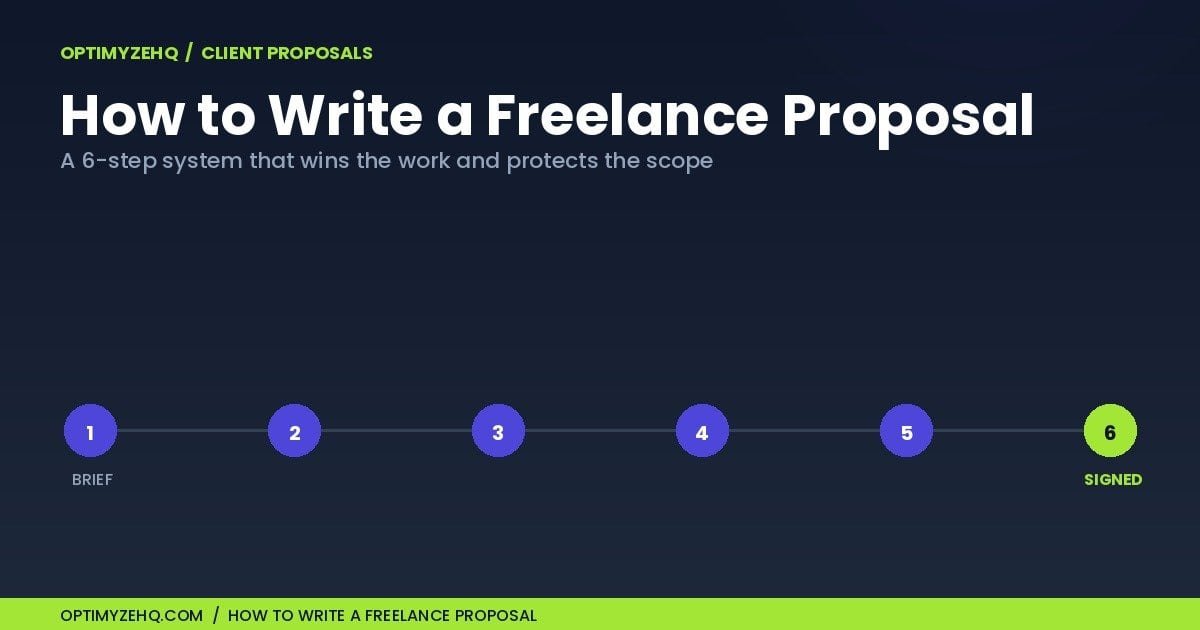
How to write a freelance proposal: the 6-step system
Structure does the heavy lifting. Get these six steps right and the proposal almost writes itself, whether you draft it by hand or with a model.
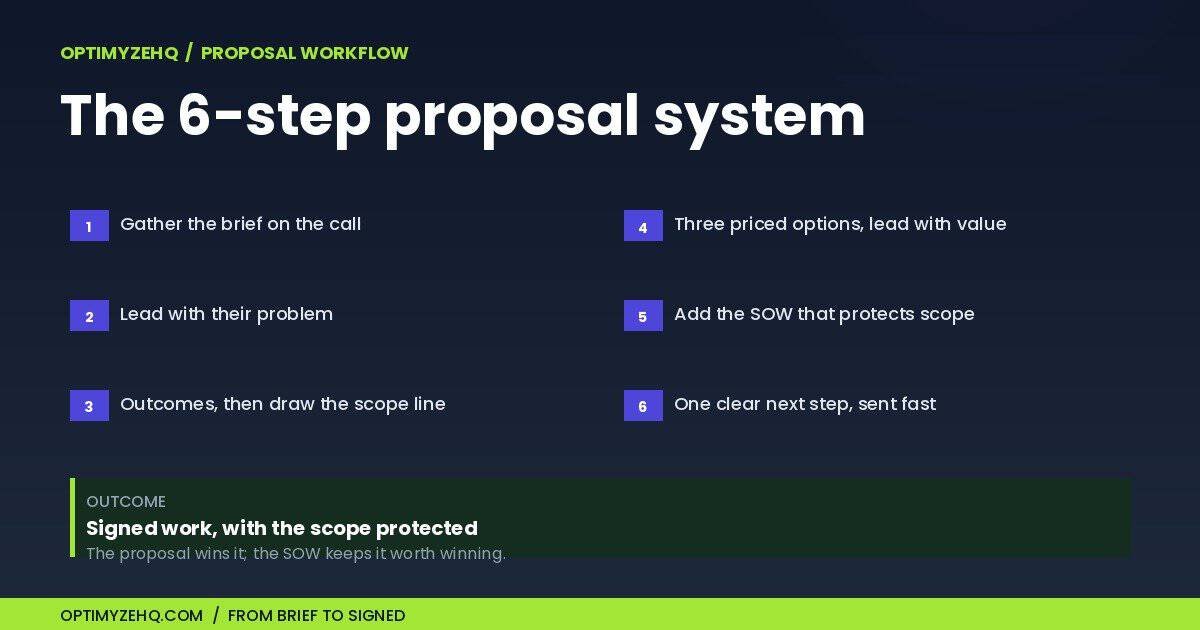
1. Gather the brief before you write
The best proposals are mostly written before you open the document. On the discovery call, capture nine things:
- The main problem, in the client’s own words
- The outcome they want
- Their current situation
- The deliverables you discussed
- A timeline or launch date
- Any signal about budget
- The constraints and exclusions
- Who actually signs off
- The agreed next step
If you cannot fill those in, you are not ready to write a proposal. You are ready to ask better questions.
2. Open with the client’s problem, not your bio
A proposal that opens with “About me” has already lost the room. Lead with the client’s situation in their own words, the cost of leaving it unsolved, and what success looks like from their side. When they read the first paragraph and think “this person gets it,” the rest is downhill. Your background matters, but it earns its place after you have shown you understood the brief, not before.
3. Turn deliverables into outcomes, and draw the scope line
Clients do not buy “five blog posts.” They buy “a content engine that brings in qualified leads.” List what you will deliver, then reframe each item as the outcome it produces. Then do the part most freelancers skip: draw the line. State what is included and, with equal clarity, what is not. A deliverable with no boundary is an open invitation for scope creep. Pair the outcomes with a realistic timeline or milestones, so the client sees not only what they get, but when.
Here is the move in one line. Weak: “I will write five blog posts.” Better: “Five search-focused articles, each mapped to one customer problem and one clear next step, designed to feed your lead pipeline.” Same work, but the second version sells the outcome and quietly fixes the scope at five.
4. Give three priced options, and lead with value
A single price invites a yes or a no. Three options invite a choice: they let the client choose the depth of engagement instead of only deciding yes or no. Offer a good, better, and best tier. Lead with the most complete option so it frames the rest. That does not mean pushing the priciest tier; it means showing the full solution first, then making the tradeoffs clear in the smaller ones. Make the difference between the tiers obvious so the decision is easy to make. Keep the numbers yours: a model can write the language around your pricing, but your rates depend on your costs, your market, and your risk, none of which it can see. For how to set those rates now that AI does much of the work, I worked through it in what to charge when AI does most of the work.
Here is the shape of it. Say you are scoping a website build: the basic tier is the core build on your standard timeline; the middle tier adds what most clients end up asking for anyway, like copy support or a faster turnaround; the top tier wraps in the extras that make it hands-off, such as training, a content load, and a short support window. Same project, three depths. Most clients pick the middle, which is usually where you want them.
5. Add the SOW that protects the win
The proposal wins the work. A statement of work keeps it worth winning. The SOW puts scope in writing: what is included, what is excluded, the assumptions you priced against, and how a change request is handled, as a change order rather than a quiet favor. It is not legal armor, and on a larger or higher-risk project it belongs alongside a proper client agreement, not in place of one. A contract covers what a statement of work does not: payment terms, liability, ownership, and how disputes are handled, so high-value or regulated work should get a proper legal review. For most engagements, though, a clear SOW is the cheapest insurance against scope creep you will ever buy. Draft it from the same brief as the proposal, then read every line yourself before it goes out. For the full version, here is how to write a statement of work in seven parts.
6. Make the next step obvious, then send it fast
End with one clear next step, not three. “Reply to approve option B and I will send the agreement and the kickoff dates” beats “let me know your thoughts.” Then send it while the call is still warm. A proposal that lands within a day of the conversation, while the client still remembers why they were excited, does better than a more polished one that arrives a week later. If you do not hear back, one short and friendly follow-up is enough.
Turn the proposal into a repeatable system
The six steps work fine for one proposal. The friction shows up on the tenth, when you are rebuilding the same scope language, the same exclusions, and the same pricing tiers from scratch every time.
Two things remove that friction. The first is AI: hand a model your brief and a short voice profile and it can draft both documents in one pass, which is the method I walk through in write a client proposal with AI. That guide focuses on the five-part proposal document a model can draft for you; this article is the six-step process around it, from the discovery call to the signed yes. The second is a system you reuse. That is what we packaged into the Proposal & SOW Engine: two tested prompts that draft the proposal and the matching SOW from a single brief, a reusable scope-and-deliverables bank, value-based pricing templates, a standard assumptions-and-exclusions library, and a full worked example to model. The six-step system above carries you a long way on its own. The Engine is for the point where proposals are a regular part of your week and you would rather start from your own saved system than a blank page. It is in founding-price release now at $67, on its way to $97.
Where to start
If proposals are occasional, the six-step system above is all you need; start with the Free AI Starter Kit for prompts you can adapt to client work. If they are a weekly part of your business, the Proposal & SOW Engine turns the whole process into a reusable workflow.
Once a proposal is signed, the next document is onboarding, which I broke down in the client onboarding checklist, and the system that runs the engagement after that is in client management for freelancers. Win the deal, protect the scope, onboard cleanly, then run the relationship from there.
FAQ
How long should a freelance proposal be?
For most projects, one to three pages. Enough to answer every question the client would ask before signing, and no more. A small job needs less than a large engagement, but past three pages you are usually hurting your close rate rather than helping it. Length reads as padding; clarity reads as confidence.
How many pricing options should I include?
Three is the sweet spot: a good, a better, and a best tier. One price invites a yes or no; three invite a choice, and the difference between them should be obvious at a glance. More than three tends to create decision paralysis, so resist the urge to list every possible package.
How soon should I send the proposal after the call?
As fast as you can without dropping the quality, ideally within a day. The proposal that arrives while the client still remembers why they were excited does better than a more polished one that shows up a week later. Speed only helps when the content shows you listened, so capture the brief well on the call and the fast turnaround takes care of itself.
What is the difference between a proposal and a contract?
A proposal is a sales document built to get a yes: the problem, the plan, the options, the price. A contract comes after the yes and sets the legal terms. The statement of work sits between them, defining scope, assumptions, and exclusions in plain language. The SOW does not replace a contract on larger work, but it is what stops most scope disputes before they ever reach one.
Should I use AI to write my proposals?
AI is good at structure and language once you give it the substance: the brief, your voice, your pricing. It is not good at judgment, so keep the rates, the scope, and the final read yourself, and never let a model invent a deliverable or a date that was never discussed. For a working method and a prompt you can paste, see our guide on writing a client proposal with AI.
How do I stop a proposal from turning into scope creep?
Write the boundary down before the work starts. A statement of work that lists what is included, what is excluded, and how change requests are handled turns “one quick addition” into a change-order conversation instead of an awkward favor. The Proposal & SOW Engine builds that scope protection into every proposal, so the line is there from day one.