
Claude vs ChatGPT for Solopreneurs: Which I Actually Use, and When
Last verified June 2026. Both tools change fast, so check the live pricing pages before you buy.
I pay for both Claude and ChatGPT, every month, on top of everything else my one-person business spends on software. People assume that is wasteful. It is not. The two tools are good at different parts of my week, and once you stop asking “which one is better” and start asking “which one for this job,” the answer gets a lot clearer.
Quick disclosure, because it matters here: I have a commercial stake. OptimyzeHQ sells products built for Claude, including Claude Skills, so I have a reason to pay close attention to it. Anthropic did not sponsor this comparison, and the links here are not Anthropic endorsements. I am going to be careful to tell you exactly where ChatGPT is the better pick for a solo creator, because pretending otherwise would make the rest of this useless to you. I run and pay for both daily, and the split below is the real one.
This guide to Claude vs ChatGPT for solopreneurs is for solo creators and freelancers deciding whether Claude earns a place next to ChatGPT in a lean stack. If you are an enterprise team comparing seat licenses, this is not your guide.
The short answer on Claude vs ChatGPT for solopreneurs
For a solo operator whose week is mostly writing, client work, thinking through long documents, and building small automations, Claude is my daily driver. For anyone whose work leans on images, voice, or live research, or who wants one app that does a bit of everything, ChatGPT is the better single pick. Plenty of us run both at $20 a month each, and that is a defensible stack, not a failure to choose.
Here is the quick version of which tool I send each job to:
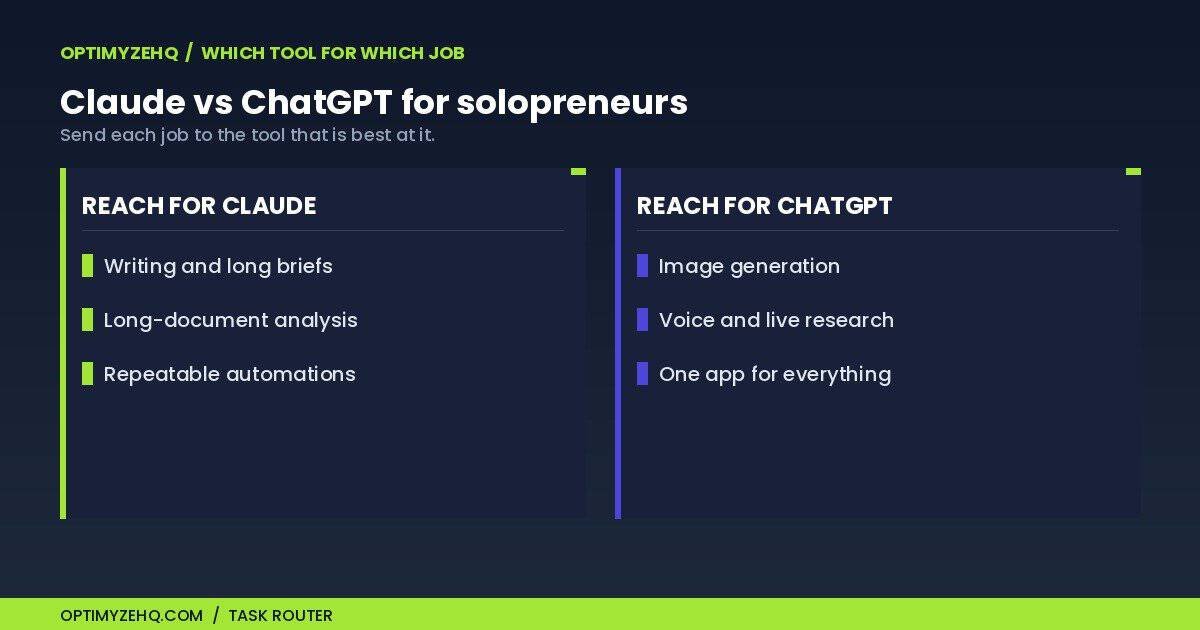
And here is the same comparison in detail, at the entry tier a solopreneur actually buys (Claude Pro and ChatGPT Plus, both $20 a month):
| The job | Claude | ChatGPT |
|---|---|---|
| Long-form writing in your voice | My pick | Strong, more generic by default |
| Following a long, detailed brief | My pick | Can lose parts of long briefs |
| Reading and reasoning over long documents | My pick (larger in-app window) | Capable, smaller in-app window |
| Generating images | No native image generation | My pick (built-in image model) |
| Voice conversations | Capable beta, fewer voices | My pick (more mature voice mode) |
| Live, multi-step web research | Has web search and research | My pick (deeper research and agent tooling) |
| Writing and fixing code | Close and contested, no clear winner | |
| Repeatable automations and operator workflows | My pick (Projects, Skills, connectors) | Strong (Custom GPTs, Agent Mode) |
| One app that does a bit of everything | Narrower, deeper | My pick (more breadth in one place) |
| Price at the individual tier | $20/mo | $20/mo |
A table tells you the call, not the why. Here is the reasoning behind each row.
I ran one real job through both
Here is a task I do most weeks: take a finished blog post and turn it into a LinkedIn post, an X thread, and a short newsletter blurb, in my brand voice, with my length rules. It is the exact job our Creator Content Engine, a paid automation, runs for me, so I know what good looks like.
Claude held my voice and my constraints on the first pass. I gave it a long brief with banned words, a tone note, and hard length limits, and it followed all of it without me re-explaining. In this run, ChatGPT was faster and gave me a couple of sharper hooks, and then did something Claude flat out cannot: it generated a clean image for the LinkedIn post in the same window. I still hand-edited both outputs, the way you should with any AI draft. But the split was clear inside one task. Claude won the words. ChatGPT won the picture. A note on method, since one task is not a benchmark: I ran this in fresh chats on each app’s default paid-plan model, gave both the same source article, brand brief, and length limits, and judged the results on instruction compliance, voice, and how much editing each draft needed, in June 2026. Treat it as a practical operating test, not a controlled study; the verdicts below lean on regular use as much as on this one run.
Where Claude is my pick for solo work
Claude wins the parts of my week that are made of words and rules. Long-form writing in a specific voice, drafting a client deliverable against a detailed brief, reading a fifty-page document and answering questions about page twelve while it is writing about page forty. In my regular use, it follows long, fussy instructions without drifting, which is the single trait that saves me the most editing time.
The operator side is the other reason it is my engine. Claude’s Projects keep a body of context and instructions in one place. Its Skills let you hand Claude a repeatable job as a reusable instruction file it runs on demand, and multiple skills compose, meaning Claude can pull several focused skills together for one task without you wiring anything. Connect it to your Notion or your files through connectors and it starts to behave less like a chatbot and more like a part of your stack. One caveat worth stating plainly: Projects, Skills, and ChatGPT’s Custom GPTs make a job reusable when you start it. They do not run on a schedule by themselves; timed or triggered automations still need a platform like Make. If you want the wider view, I lay out the whole case for running a solo business on Claude.
That operator layer is why OptimyzeHQ builds on Claude, and it is the honest reason this piece leans the way it does. If that repeatable-work angle is what you care about, I have written separately on whether Claude Skills are worth it for a solo business and how to build your own Claude Skill from scratch, both free. The method in them is the whole method; the only part worth paying to shortcut is the building.
Where ChatGPT genuinely wins
ChatGPT wins anything visual, anything voice-first, and anything you want done in one place. This is not a courtesy paragraph. For a real slice of solo work, ChatGPT is the correct tool, and if your business lives here you should buy it over Claude.
Images are the clearest line. ChatGPT generates images natively from a prompt, with its updated 2026 image model, available from its free tier up. Claude does not generate photographic images at all. Claude can analyze images you upload, produce SVG charts and diagrams, and build presentations and mockups through Claude Design, its built-in design and document-creation feature, but if you need a graphic for a post or a thumbnail for a video, ChatGPT does it in the same chat and Claude sends you to a separate tool. Neither one generates video inside the chat today, after OpenAI retired its consumer video app in 2026, so on video it is a wash.
Voice is the second line. Both have a voice mode now, but ChatGPT’s is more mature, with a more natural real-time feel and more voices. Claude’s is a capable beta that works well enough for hands-free dictation. If voice is core to how you work, ChatGPT is ahead.
Live research is the third. Both can search the web. ChatGPT’s deeper research and agent tooling are further along for the kind of multi-step “go find and synthesize this across twenty sources” job, and that is a genuine edge for anyone doing heavy research. And breadth is the fourth: ChatGPT does more things in one subscription, while Claude is narrower and deeper. If you want a single app to be your whole AI layer, ChatGPT is the more complete answer.
The three things people get wrong: context, coding, and privacy
These are the claims I see repeated in nearly every comparison, and most of them are out of date.
Context window is not the clean Claude win it used to be. At the $20 tier, Claude does hold the larger working memory inside the app, which is why it is better at long documents in everyday use. But on the developer side that gap has closed: on the API, the largest current OpenAI and Anthropic models offer comparably huge context windows, so context is no longer a clear Claude advantage there. So if you are chatting, Claude’s longer in-app memory is a real advantage. If you are building on the API, treat context as a tie, not a Claude trophy.
Coding is close and contested. Each vendor leads different benchmarks this season, the numbers shift every few weeks, and some of the popular tests have known accuracy problems. Both are genuinely strong at writing and fixing code for a non-developer. I will not hand you a fake winner here. Try both on your actual code and trust that over any leaderboard.
Privacy is roughly the same, despite the reputations. On the consumer plans, both Claude and ChatGPT train on your chats by default unless you opt out, and both exclude business, team, and API data from training by default. The policies are materially the same, so do not pick one over the other expecting a consumer privacy edge that is not there. One real difference: ChatGPT’s Free and Go plans now show ads in some regions, and Claude does not show ads on any plan. That is narrow, but it is true. Either way, the practical rule for client work is simple: do not paste confidential client material into a consumer plan without checking its data controls, turn training off, and for anything sensitive use a business or API plan, where neither company trains on your data by default. Both also reserve the right to review flagged conversations for safety regardless of that setting, so a consumer account is not the place for truly confidential files.
What Claude vs ChatGPT actually costs a solopreneur
Stating prices once, dated. As of June 2026, Claude Pro and ChatGPT Plus both cost $20 a month (Claude is $17 a month if you pay annually). Each has a free tier you can test first, and each has heavier $100-and-up tiers for power users. Always check the live pricing pages before you buy, because both move. And if your usage is light, you do not need to pay yet at all: start on both free tiers and upgrade only when usage limits start interrupting paid work, or you need a paid-only feature.
The cost that catches solopreneurs off guard is the automation cost. The $20 plan covers you chatting in the app. The moment you wire either model into a tool like Make to run a workflow automatically, you are on separate, pay-per-use token pricing on top of the subscription. As a rough guide in June 2026, a small automation that turns each new blog post into a batch of social drafts costs pennies per run on a mid-tier model, so a light publishing cadence runs well under a dollar a month, while a heavy client workload scales to a few dollars. To put a number on it, a 1,500-token prompt with a 500-token reply on a mid-tier model is about a cent per run at June 2026 rates. The exact figure swings with the model and how long your prompts are, so treat that as an order of magnitude, not a quote.
So which should you pick?
Pick by the shape of your work, not the brand on the box.
- Your work is visual or voice-first. Social graphics, thumbnails, image-heavy content, voice notes. Buy ChatGPT.
- Your work is writing, client deliverables, and automations. Long-form content, briefs, document analysis, repeatable workflows in your stack. Buy Claude.
- You need one subscription to cover the widest range of tasks. Buy ChatGPT for the breadth, or run both at $20 each if each one regularly saves you time. For someone who uses both several times a week, the combined $40 can cost less than the editing time lost forcing every job through one tool.
FAQ: Claude vs ChatGPT for solopreneurs
Is Claude or ChatGPT better for solopreneurs?
Neither wins outright. Claude is the stronger pick for writing, client deliverables, long-document work, and repeatable automations. ChatGPT is the stronger pick for image generation, voice, live research, and having one app that does a bit of everything. Choose by the work you do most.
Is Claude better than ChatGPT for writing?
In my experience, yes, for two reasons: it tends to hold a specific brand voice more faithfully, and it follows long, detailed briefs without drifting. ChatGPT writes well too and is often faster, but its default voice is more generic and it loses parts of very long prompts more often.
Can I use both Claude and ChatGPT?
Yes, and many solopreneurs do. At $20 a month each, you can send each job to the tool that is best at it: words and automations to Claude, images and deep research to ChatGPT.
Which is cheaper, Claude or ChatGPT?
At the individual tier they are the same: $20 a month, or $17 for Claude billed annually. Both have free tiers. Costs only diverge when you build API automations, where you pay per use instead of a flat subscription.
Can Claude generate images?
No. As of June 2026, Claude does not generate photographic images from a prompt. It can analyze images you upload, create SVG charts and diagrams, and build slide decks and mockups through Claude Design, but for prompt-to-image generation you would use ChatGPT or a dedicated image tool.
Pick by the job, not the brand. Your answer should follow your weekly workload, not mine. If your edge is repeatable work a tool can run for you, the Solo Operator Skill Pack is the paid shortcut, and the two Skills guides above are the free path to the same place.