
How to Write a Statement of Work: The 7 Parts That Protect the Scope You Sold
The proposal got a yes. Three weeks later the same client is asking for a second landing page, a “quick” logo tweak, and a launch date nobody agreed to, and you have nothing to point back to. That gap, between the deal you sold and the deal you are somehow now delivering, is where freelance projects quietly bleed money.
A statement of work closes that gap. It is the document you write after the proposal is accepted: the one that turns “sounds great, let’s do it” into a specific, signed agreement about what you will deliver, by when, and what falls outside the job. Plenty of freelancers skip it, then spend the back half of every project negotiating from memory.
This is a guide to how to write a statement of work that holds up when a project gets complicated. It will not stop a client from asking for more, because nothing does. PMI’s research has found scope creep hits more than half of all projects. What a good SOW gives you is a written reference point, so the next out-of-scope request becomes a short pricing conversation instead of unpaid work and a tense email thread.
If you have not sent the proposal yet, start one step earlier with the 6-step freelance proposal process. The statement of work picks up where that leaves off.
How to write a statement of work: the 7 parts
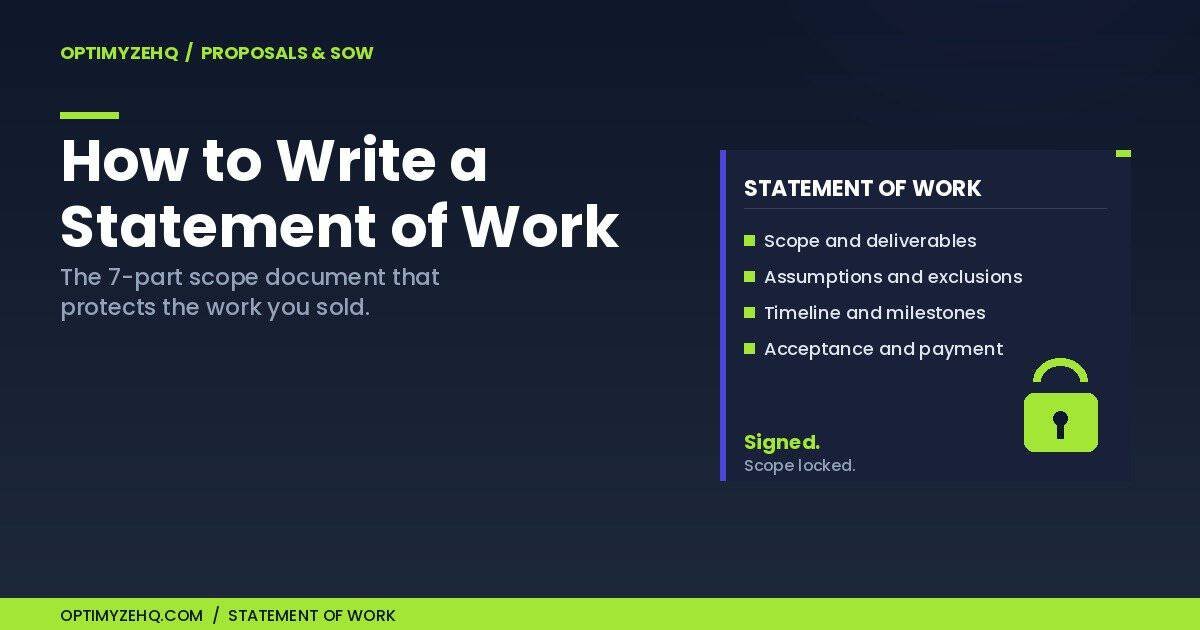
A statement of work has seven working parts. The useful way to write each one is not “what goes in this section” but “which argument does this section prevent.” Write through that lens and the document stops being paperwork and starts being protection.
1. Overview and purpose. Two or three sentences naming the client, the project, and the outcome it is meant to produce. This prevents the slow drift that starts when a new contact joins the client side three weeks in and has no idea what was agreed. Anchor it: who the parties are, and the one-line result the work delivers.
2. Scope of work. The tasks and the approach, the what and the how. One naming note: this section is also called the “scope of work,” which is exactly why people confuse the two. The scope of work is a part of the statement of work, not a synonym for it. Write it as specifics, not verbs: “design and build a 5-page marketing site in WordPress,” not “build a website.” The vaguer the verb, the wider the door.
3. Deliverables with a definition of done. List the actual outputs, and for each one, the condition that marks it finished. This is what ends the endless-revision loop. Spell out the revision count too; two rounds per deliverable is the common freelance default, with a third round billed at your change rate.
4. Timeline and milestones. Phased dates, not one final deadline, and a defined client-review window at each step. This kills the pattern where the client goes silent for two weeks and then treats the original deadline as sacred. Make the review window explicit: “Client has 3 business days to review each draft; review time beyond that shifts the final date.”
5. Assumptions and exclusions. What you are counting on the client to provide, and an explicit list of what the project does not include. This is the single most useful part of the whole document. It is the cure for “I assumed that was included.” Write the exclusions as a flat list: “This scope does not include copywriting, paid-ad creative, or SEO research.”
6. Acceptance criteria. How both sides agree the work is done. The definition of done in part 3 settles each deliverable; acceptance criteria are the milestone-level sign-off that closes the work. This keeps the sign-off from becoming a moving target. Make it measurable where you can (“pages load in under 3 seconds on the staging URL”) and a clear sign-off step where you cannot.
7. Payment terms. Amounts tied to milestones, not one lump sum at the end. This is what keeps you from finishing everything and then chasing an invoice. A common shape: a deposit to start, a payment at first-draft approval, the balance on final delivery.
Many freelancers add an eighth part: a change-control line that says how new requests get handled once work begins. It earns its own treatment, below.
The one line that does the most work
The difference between a SOW that protects you and one that does not usually comes down to a single habit: writing outcomes and boundaries instead of vague verbs.
Weak: “Build a website.”
Better: “Design and build a 5-page marketing website in WordPress (Home, About, Services, Blog, Contact). Includes 2 rounds of revisions per page. Copy supplied by the client. Does not include logo design, hosting setup, or ongoing maintenance.”
The second version is not longer because it is more formal. It is longer because every clause closes a door a client would otherwise walk through. Specificity, not legal language, is what does the work.
The non-negotiables, in a single checklist
If you keep only one thing from this guide, keep this. A usable statement of work answers seven questions in writing:
- What exactly are you delivering, and what marks each piece done?
- What is explicitly not included?
- What are you assuming the client will provide?
- When is each milestone due, and how long does the client have to review?
- How much, and paid against which milestones?
- How are new requests handled once work starts?
- Who signs, and when does the clock start?
Answer those, get a signature, and you have a working SOW. Everything else is refinement.
A statement of work is not a contract
A statement of work signed by both parties can be legally binding, so do not treat it as throwaway paperwork. It is also not a full contract. A contract, or a master services agreement that your SOWs sit under, covers the relationship-level terms a SOW usually leaves out: liability limits, who owns the intellectual property, confidentiality, indemnification, dispute resolution, and how either side can end the engagement. The SOW handles the what and the when; the contract handles the what-if.
For a small project with a client you trust, a clear signed SOW is often enough. For high-value, regulated, or IP-sensitive work, have a lawyer review the agreement before you sign. This guide is a starting structure, not legal advice.
After it is signed: change orders, not silent extra work
The moment a client asks for something outside the signed scope, your job is not to quietly do it. It is to name it as a change, price it, and get a yes before you start.
That is a change order: a short written note describing the new request, what it adds to the cost, and what it does to the timeline. “Change order” is the standard term, borrowed from construction and used the same way by agencies and freelancers. It does not have to be formal. A two-line email that references the SOW does the job: “That second landing page is outside our agreed scope. I can add it for $X, and it moves final delivery to [date]. Want me to proceed?”
The SOW is what makes that email easy to send. Without it, you are arguing about what was agreed. With it, you are pointing at a document you both signed. The SOW does not enforce itself, and it will not make a difficult client reasonable. What it gives you is the footing to charge for the work instead of absorbing it.
A starter prompt: turn your accepted brief into a first draft
You do not have to write a SOW from a blank page. If you already have the proposal or the call notes, a general AI assistant like Claude or ChatGPT can turn them into a first draft you then tighten.
Here is a starter prompt. Paste your project details where marked:
You are helping a freelancer write a statement of work for a client
project that has already been agreed in principle. Using the brief
below, draft a statement of work with these sections: overview and
purpose; scope of work; deliverables (each with a clear definition of
done); timeline and milestones (with client review windows);
assumptions and exclusions; acceptance criteria; and payment terms
tied to milestones.

Be specific. Write the exclusions as an explicit list of what is NOT
included. Where a detail is missing from the brief, insert a clearly
marked [PLACEHOLDER] instead of inventing it. Use a plain,
professional tone.

Brief:
[paste your proposal, call notes, or a few bullet points here]
Two cautions. First, the draft is a draft. The model will guess at numbers, dates, and deliverables it cannot know, which is why the prompt forces visible placeholders instead of invented detail. Check every one before the document leaves your hands.
Second, mind what you paste. Consumer AI chat tools can use what you type to train their models unless you turn that off in settings, and flagged conversations may be read by a human reviewer even then. Before pasting a real brief, strip client names and anything confidential, or use a business or API tier where inputs are not used for training by default. When in doubt, check your settings.
Turn it into a system
If you send proposals regularly, writing each SOW by hand, even from a prompt, gets old fast. That is the gap the Proposal & SOW Engine, a paid Claude-and-Notion system, is built to fill.
It drafts the proposal and the matching statement of work from the same brief, so the two documents never disagree about scope, deliverables, or price. It ships with reusable banks for deliverables, pricing language, and exclusions, so you drop in tested wording instead of writing each clause fresh. Founding price is $67, moving to $97.
It removes the drafting and the blank-page friction. It does not remove the judgment: you still set the scope, choose the numbers, and read the room. The method in this guide is the whole method. The Engine is the shortcut through it.
Where to read next
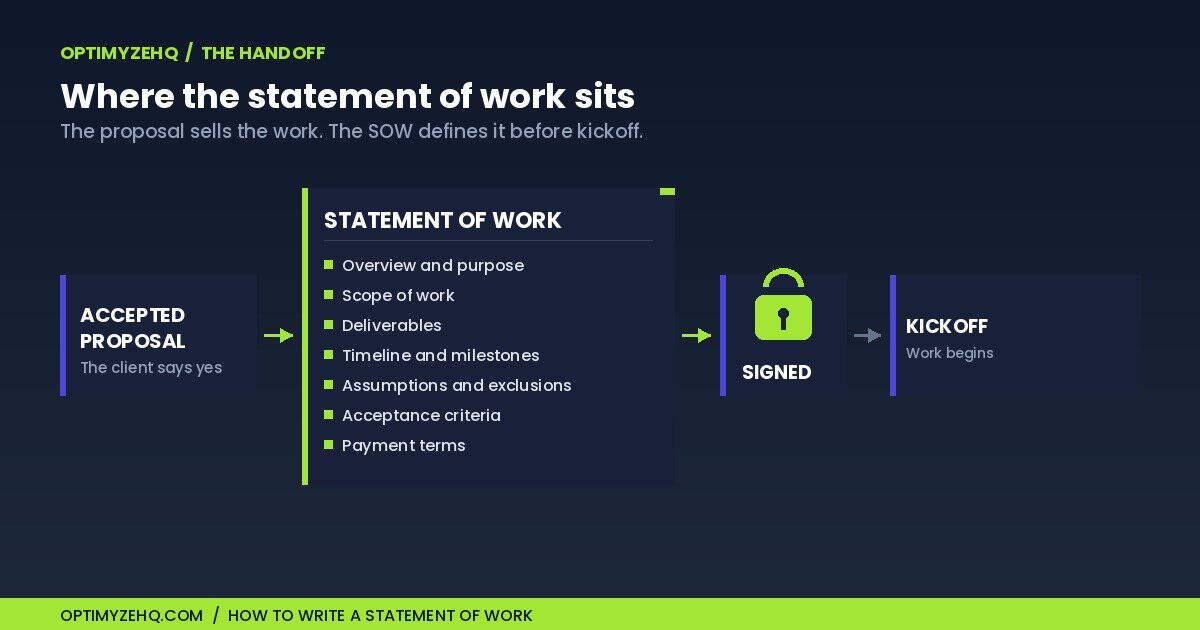
A statement of work is one document in a sequence. Here is where it sits.
Before the SOW comes the proposal, the document that wins the work. For the foundational version, the 6-step freelance proposal process walks through writing one from scratch, with or without a model. If you would rather draft it with AI, the 5-part AI proposal method is that same job with a model doing the writing. Those two cover the proposal, the five-part document that sells the work. This guide covers the statement of work, the document that defines it once the client says yes.
After the SOW is signed, the work begins, and a clean kickoff protects the goodwill you earned. The Client Onboarding Toolkit covers that handoff.
FAQ
When do I write the statement of work, before or after the proposal is signed?
Usually after. The proposal sells the work and gets a yes; the statement of work defines the work in detail and gets a signature before you start. The exception is small projects, where a single combined proposal-and-SOW, or a detailed contract, can do both jobs. The sequence matters less than getting specific scope in writing before any work begins.
What is the difference between a statement of work and a scope of work?
The scope of work is one section inside the statement of work. It describes the tasks and the approach, the what and the how. The statement of work is the whole document, wrapping that scope together with deliverables, timeline, payment, and conditions. The confusion comes from both being abbreviated SOW. When a client says “send me the SOW,” they almost always mean the full statement of work.
Is a statement of work legally binding, and does it replace a contract?
A statement of work signed by both parties can be legally binding, so treat it seriously. It does not replace a full contract, though. A contract or master services agreement covers liability, intellectual-property ownership, confidentiality, and dispute resolution, the terms a SOW usually leaves out. For high-value or regulated work, have a lawyer review the agreement before you sign.
How do I handle work the client asks for after the SOW is signed?
With a change order. Name the request as outside the agreed scope, state what it adds in cost and time, and get approval before you do it. A two-line email that references the signed SOW is enough. The point is to price new work instead of absorbing it.
Do I need a separate statement of work for small projects?
Not always. For a short, low-risk project with a client you trust, a detailed proposal or a simple contract can carry the scope on its own. The value of a separate SOW grows with the size, length, and ambiguity of the project. Match the document to the risk.
Can I reuse one statement of work across clients?
Reuse the structure, not the content. The seven parts stay the same; the deliverables, exclusions, and numbers change every time. Keeping a bank of tested deliverable and exclusion lines is what makes each new SOW fast to write. (The Proposal & SOW Engine ships those banks ready to use.)