
Is Vibe Marketing Worth It? An Honest Verdict After I Ran One on My Own Stack
Vibe marketing is the name for letting AI and a no-code tool draft and assemble your campaigns from a plain-English prompt, and right now it is everywhere. So is vibe marketing worth it for a one-person business, or is it one more thing the internet is overselling? I stopped reading the launch threads and ran a real one, on the same stack I use every day, and I wrote down what actually happened instead of what the demos promise.
The short answer
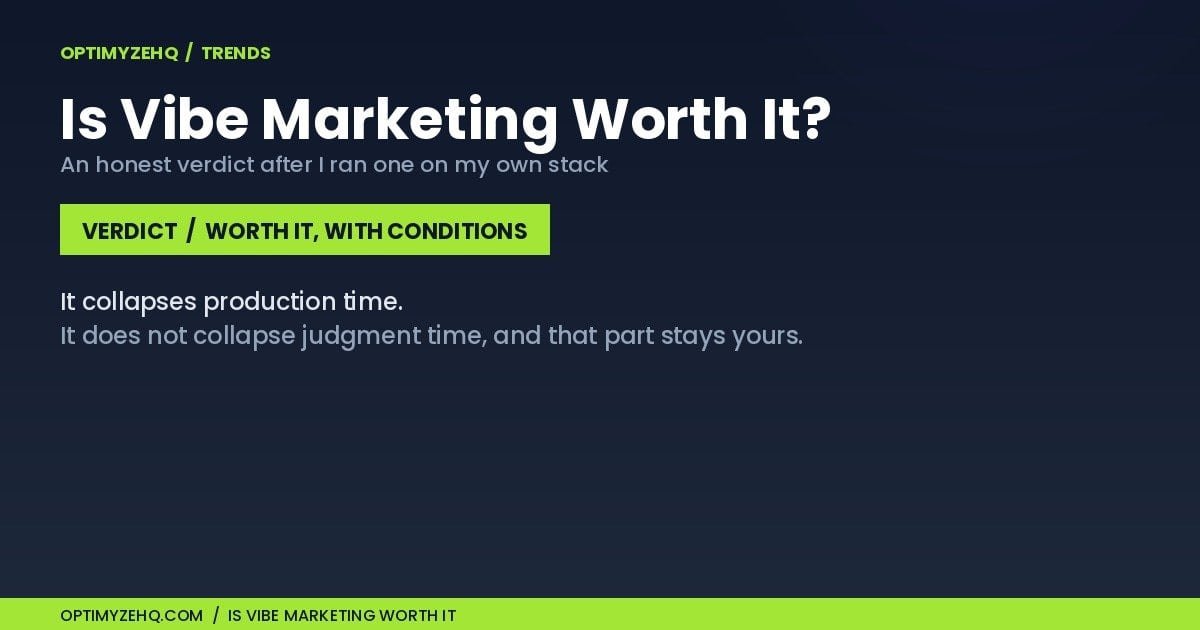
Yes, with conditions. Vibe marketing is worth it for a solopreneur if you treat it as a supervised production accelerator. It drafts the first version of a campaign in minutes, and you stay the editor who approves every piece before it goes out. It is not worth it if you treat it as a launch-it-for-me button, because that is exactly where the hype, the broken workflows, and the brand damage live. The speed is real. The judgment is still yours, and that is the part that does not automate.
The rest of this article is the run that got me to that answer.
What vibe marketing actually is, minus the hype
Strip the buzzwords and the idea is plain: you describe the campaign you want in everyday language, and generative AI plus a no-code automation tool produce the drafts, so one person ships what used to take a small team. That is the whole concept. The name is a riff on “vibe coding,” a term Andrej Karpathy coined in February 2025, and the marketing version was popularized a month later by Greg Isenberg.
The search interest climbed fast after that. By one SEO trend tracker’s count (Exploding Topics, as cited by MarTech), queries for the term rose nearly 700% in its first year, from roughly a thousand a month to several thousand. That number tells you the term is hot. It tells you nothing about whether the output is any good. So I built one instead of reading about it.
I ran a real one: one idea, five assets, my own stack
Here is the exact brief I typed, nothing tidied up:
Promote the Free Starter Kit to time-poor solopreneurs. Lead with one concrete automation they can run this week (turn one blog post into a week of content with Claude and Make). Honest tone, no hype. Link to the kit.
The Free Starter Kit is our free pack of prompts and workflows, so this was a promotion I would actually send. The stack was the one I run daily: Claude drafted the assets, and Make routed each draft into a Notion board where it sits and waits for my approval. Nothing posts on its own.
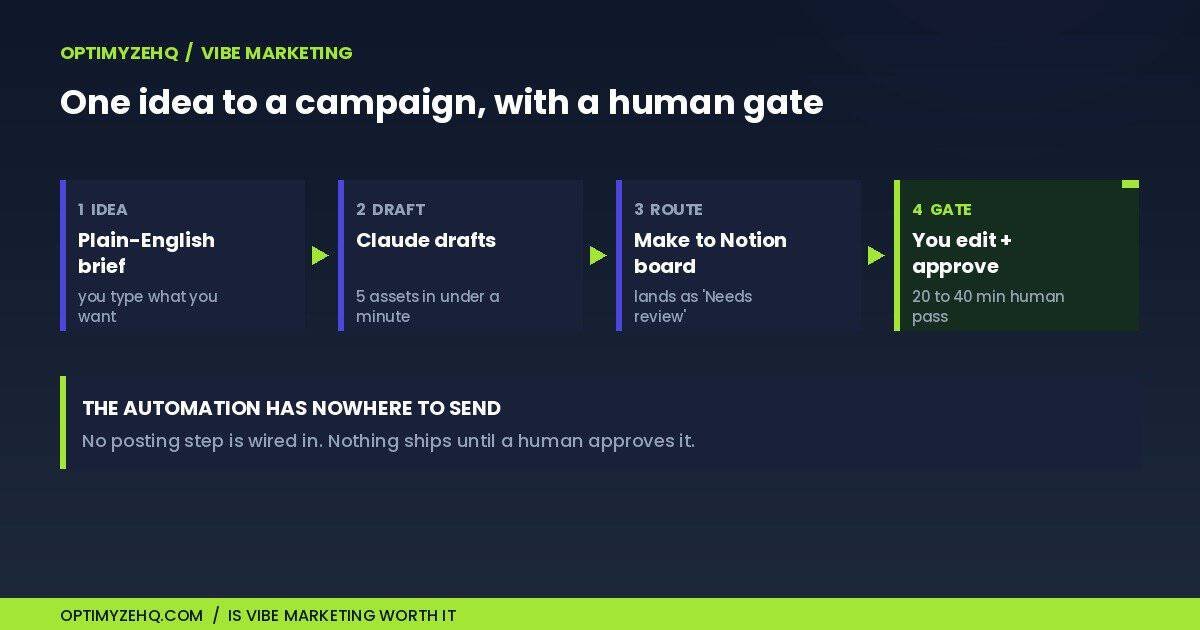
From that single brief I had five drafts in under a minute: a LinkedIn post, a short X version, casual Threads and Bluesky variants, and an email nudge. Here is the LinkedIn draft, trimmed, after my pass:
Last year I spent most Sundays turning one blog post into social posts by hand. Copy, reformat, rewrite the hook five times, schedule. Three hours, gone. Now a small Claude and Make workflow does the first pass while I make coffee. It is not magic. I still read every draft, cut the lines that sound like a robot, and approve before anything ships.
Recognizable as mine. Not shippable as written. Every asset needed a human pass, and that pass is the whole story.
What broke, the part the hype guides skip
Before a single one of those drafts was usable, here is what I had to fix. None of it shows up in the launch threads.
- The drafts ignored each channel’s rules. The first X version ran past the character limit. A plain-English prompt does not carry your platform limits on its own. The fix is to bake the constraints and brand rules into the system prompt once, then feed corrections back in when something slips. That feedback loop is the line between a vibe prompt and an actual workflow.
- The voice drifted toward hype. First passes reached for “effortlessly” and a tidy stat, “saves three hours every week,” that I can honestly state only as my own past experience, not a promise to a reader. Both got cut.
- It sprinkled em-dashes, the punctuation a lot of readers now clock as “a machine wrote this.” Keeping them out was a manual rule, not a default. Amplitude’s own vibe-marketing guide flags the same tell.
- Every channel wanted to say the same thing the same way. Left alone, LinkedIn, X, and Threads converged on one shape. I had to force a different length and register for each.
- It stated offer facts I never gave it. The drafts confidently described what the kit contains and promised “no upsell wall.” True, as it happens, but only because I checked. The model did not know that. It guessed.
One line makes the difference concrete. The draft offered: “Effortlessly turn one blog post into a week of content and save three hours every week.” What shipped: “Turn one blog post into a week of first drafts, then publish only what still sounds like you.” Same idea, minus the false promise and the robot sheen.
Five assets. Five rounds of judgment. That is the part the speed demos cut out.
The honest math: it collapses production time, not judgment time
Here is where the hype and the reality split. The drafting was close to instant. The five assets landed in well under a minute. The same five assets used to cost me the better part of a Sunday morning by hand, a couple of hours of copying, reformatting, and rewriting hooks. But the part that made them safe to publish took a focused block of roughly twenty to forty minutes: reading each one, cutting the robotic lines, fixing the character limit, and checking the facts I never gave it. For a five-piece mini-campaign, that is the real number. Even standing up the automation that routes drafts to my review board came with friction the demos never mention: it sits there doing nothing until you switch it on, and wiring that first connection correctly is its own small job.
So the speed is real, but it lands in one place only. Vibe marketing collapses production time. It does not collapse judgment time, which is where a brand is made or lost.
That matters because the numbers being sold are mostly about the wrong half. The widely repeated “20x speed boost” traces back to Greg Isenberg’s launch posts, and vendor blogs pile on bigger multipliers for speed, cost, and revenue, none backed by a primary study you can check. Treat them as marketing claims about a marketing tool, not benchmarks.
The honest version is smaller and more useful: you get your evenings back from the production grind, and you spend a fraction of that saved time being a sharper editor. That is a genuinely good trade. It is not a 20x one, though. One honest limit on this verdict: I am judging the production half, the speed and quality of getting good drafts made. Whether AI-assisted copy converts as well as something written slowly by hand is a separate test, and it is not the one I ran here.
Where it is genuinely worth it, and where it bites
The line is clear once you have run it. Vibe marketing earns its place on the repetitive production work, the drafting and reformatting and first-pass variants that drain a solo week. It bites the moment you let it touch the things that are supposed to sound like a person.
| Worth it for | Bites when |
|---|---|
| First drafts of social posts, emails, ad variants | You publish the draft without an editing pass |
| Reformatting one idea into many channels | You let it set your brand voice instead of following it |
| Beating the blank page on a busy week | You treat it as a send button instead of a draft button |
| Routine production you already know how to judge | The output is the customer relationship itself |
The biting end is not hypothetical, and the risk environment is well documented. These studies measure reactions to AI-generated content in general, not vibe marketing specifically, but vibe marketing is how a solo operator produces AI content at volume, so they are the conditions you are operating in. Consumer preference for AI-generated creator content fell to 26% in 2025 from 60% two years earlier, by one Billion Dollar Boy survey reported by Net Influencer. A March 2026 Gartner survey found half of consumers prefer brands that avoid generative AI in the content they see. The Content Marketing Institute put the strategic objection most plainly: marketing does not compile. Speed does not equal resonance, and more off-brand content only means more of the wrong thing. The important distinction is that these studies are not telling you never to use AI. They are punishing output that reaches the reader raw, generic, and obviously machine-made, which is exactly what an editing pass and a human gate are built to prevent.
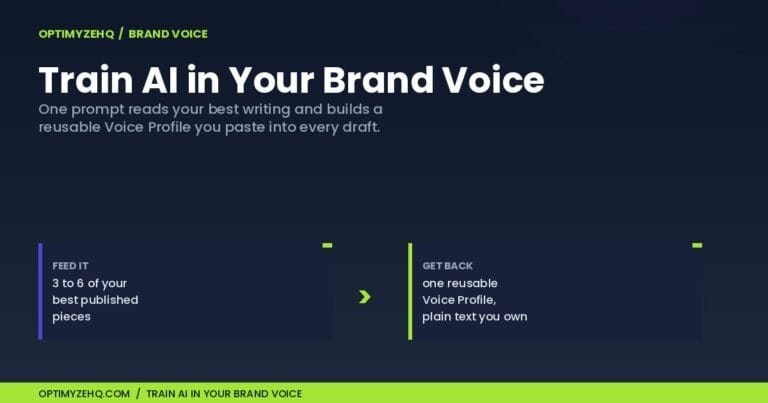
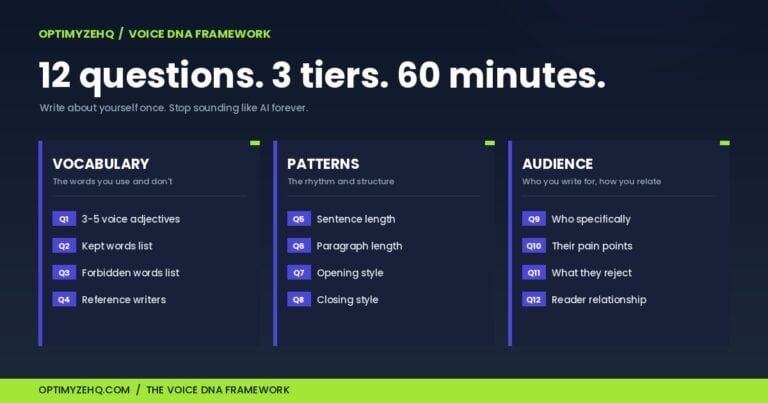
This is why brand voice is the hinge, not a nice-to-have. The drafts in my run drifted toward generic hype until I pulled them back, and the only reason I could pull them back fast is that I keep my voice written down as a reusable file rather than re-explaining it every time. If you have not done that yet, it is the single highest-impact thing to fix before you scale any AI workflow, and I wrote up exactly how in train AI in your brand voice. As one of our earlier pieces put it, your voice should be a file, not a vibe.
The part that has to stay human, and why a review board beats a send button
The most important design choice in my run was not a prompt. It was that the workflow has nowhere to send.
When Claude finished drafting, Make did not post anything. It dropped each asset into a Notion board as “Needs review,” where it waits for me to read it, edit it, and approve it. The automation literally cannot publish on its own, because I never wired a posting step into it. That is not discipline I have to remember every morning. It is structural. The human gate is built into the shape of the system. Call it the review-board rule: the system can draft, format, and route, but it cannot publish. That one constraint is the difference between a tool you control and a bot that posts something you would never have approved.
I would tell any solo operator to build it exactly this way: let AI draft, let the no-code tool move the drafts somewhere you can see them, and keep the approval in your hands. If you want to wire that orchestration yourself, the build sits in our existing guides rather than here, because this article is about whether vibe marketing is worth it, not how to construct the pipeline. Start with Make.com and Claude for the workflow basics, the no-code AI content pipeline for the step-by-step, and building an AI agent in Make when you want it to make more decisions on its own. All of it is one more system inside the bigger picture of AI workflows for solopreneurs.
Should you use vibe marketing? A quick readiness check
Run through this before you wire anything up. It is less about the tools and more about whether you are ready to direct them.
Use it if:
- You already know what good output looks like in your niche.
- You have your brand voice written down, not only in your head.
- You read every draft before it goes out.
- You are repurposing ideas you already have, not inventing strategy from scratch.
- You have one clear goal for the campaign.
Hold off if:
- You do not yet know your audience or your offer.
- You plan to publish on full autopilot.
- You are asking the AI to invent facts, claims, or proof.
- You cannot give each draft a careful read.
- You want it to tell you what to say, not help you say it.
Is vibe marketing worth it? The verdict
Yes, for a one-person business, vibe marketing is worth it, as long as you are honest about which half of the work it actually does. It is a fast, capable drafting layer that gives you back the hours you used to spend pushing words between formats. It is not a replacement for taste, brand voice, or the judgment to know when a draft is not good enough to send. Run it on a stack you control, keep a human approval gate, and ignore the multiplier math, and it is one of the better trades available to a solo operator right now. Treat it as a magic button, and it will quietly produce more off-brand content faster than you can clean it up.
If you want the drafting workflow I used here, the review-board version rather than an auto-posting bot, it is in our free Starter Kit. No charge, and no upsell wall.
Frequently asked questions
Is vibe marketing only a buzzword?
The name is buzzy, but the practice underneath is real: using generative AI and a no-code automation tool to draft and route campaigns from a plain-English prompt. The term is a deliberate riff on “vibe coding.” The label will fade. The workflow of one person directing AI to produce a team’s worth of drafts is here to stay.
Is vibe marketing worth it for a solopreneur specifically?
This is where it fits best, because a solo operator has the most production work and the least time. The catch is that it only helps if you stay the editor. The value is the hours saved on first drafts, not a hands-off campaign that runs itself.
What tools do you need for vibe marketing?
At minimum, one capable AI model to draft, such as Claude, and a no-code automation tool to move the drafts, such as Make. A place to review and approve, like a Notion board, is what keeps a human in the loop. You do not need an expensive all-in-one platform to start.
Does vibe marketing replace marketers?
No. It replaces some of the production work a marketer does, not the strategy, the brand judgment, or the relationship with the audience. In a one-person business, it changes how you spend your marketing time. It does not remove the need for you to make the decisions.
Will AI-generated content hurt my brand?
It can, if you publish it unedited. Consumer trust in obviously AI-generated content is measurably lower, and off-brand output at scale erodes the voice that makes people choose you. The fix is an editing pass and a written brand voice the model follows, not avoiding the tools entirely.
Where did the term vibe marketing come from?
It grew out of “vibe coding,” which Andrej Karpathy coined in February 2025 to describe building software by describing what you want and letting AI write it. Greg Isenberg popularized the marketing version a month later. The idea in both cases is the same: you set the direction, the AI handles the execution, and you stay responsible for the result.