
What to Charge When AI Does 80% of the Work
If you sell content services in 2026, you have already gotten this email or you will soon: “I’m guessing you use AI for some of this now. Can we revisit the rate?” That one question is why AI freelance pricing in 2026 is a different game than it was even a year ago, and why the instinct it triggers is the most expensive one you have this year.
The instinct is to discount. To knock 20% off because the draft took two hours instead of eight. To feel a little guilty charging the old number for the new speed.
Don’t. Discounting because AI made you faster is not a goodwill gesture. It is a structural mistake, and the freelancers making it are quietly training an entire market to pay them less for getting better at their jobs. This is a guide to what to charge instead, what the 2026 data actually says about rates, and the honest version of where this advice stops working.
The efficiency paradox is doing your pricing for you
Here is the trap, stated plainly. If you bill by the hour, every hour AI saves you is a pay cut you handed yourself. Get twice as fast and you earn half as much for the same finished work. The better you get at the new tools, the less you make. No client did that to you. The pricing model did.
Jonathan Stark has been making this argument since long before generative AI existed, in his book Hourly Billing Is Nuts: when you sell time, you are financially punished for being efficient, and the buyer carries none of the risk of the estimate. AI did not create that flaw. It just turned a slow leak into a burst pipe. A writer who shaved a 40-hour month down to 15 hours did not get a productivity bonus. On an hourly model, they got a 60% pay cut and called it progress.
| Same $5,000 deliverable | Billed hourly | Priced as an outcome |
|---|---|---|
| Takes 40 hours | $125/hr | $5,000 |
| Takes 20 hours (with AI) | $2,500 total, a 50% pay cut | $5,000, a $250/hr effective rate |
| Who keeps the efficiency gain | The client | You |
| Who carries the estimate risk | You | You, and you priced for it |
So the real question is not “what should my hourly rate be now that I use AI.” The question is “what am I actually selling, if it was never really the hours.” Answer that and the pricing follows.
The market split, according to the people who counted
The “AI hollowed out the middle of freelancing” claim gets repeated everywhere, usually with no evidence attached. It turns out there is evidence, and it is more specific and more uncomfortable than the slogan.
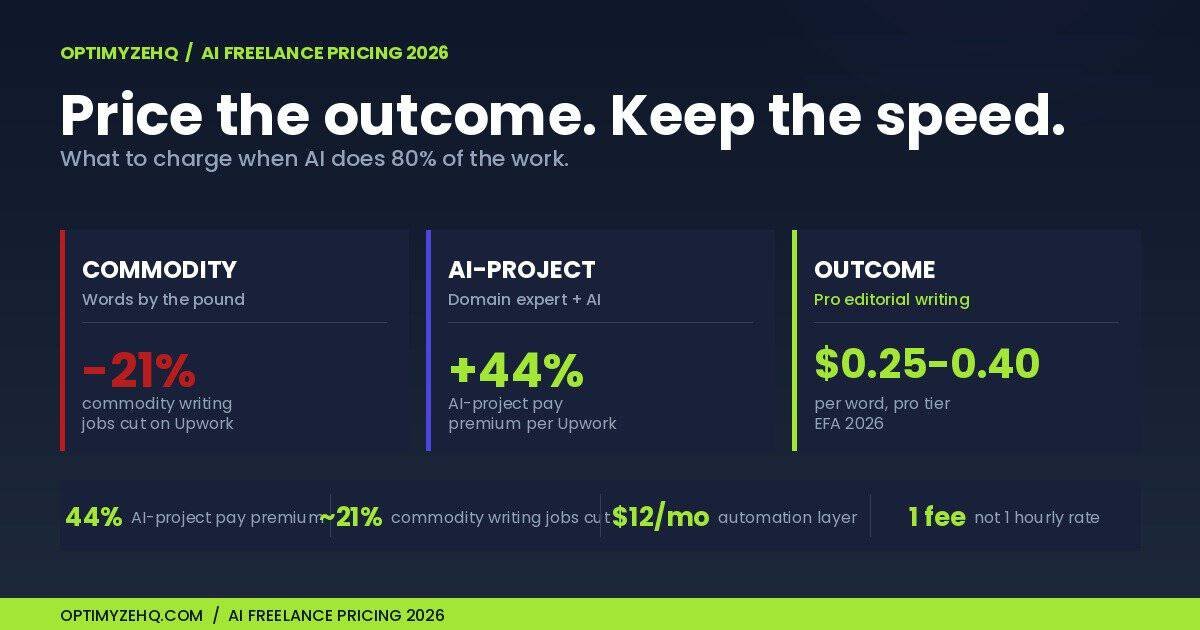
A 2025 study published in Management Science by Demirci, Hannane and Zhu analyzed roughly 1.7 million freelance job posts and found that automation-prone work like writing fell 21% within eight months of ChatGPT’s launch. The part worth tattooing on the wall: the jobs that survived the cull were, on average, of higher complexity and higher pay. The floor fell out. The ceiling did not. A separate study in Organization Science by Hui, Reshef and Zhou, looking at Upwork around the same window, measured the damage on the writing side at roughly a 5% drop in monthly earnings on average. Average is the operative word, and we will come back to it in the honest section.
A separate paper from Ozge Demirci (Harvard Business School), Jonas Hannane (DIW Berlin) and Xinrong Zhu (Imperial College Business School), published in Management Science in late 2025, looked at nearly two million job postings across 61 countries and found a 21% drop in automation-prone freelance work, writing and coding combined, within eight months of ChatGPT’s launch. The category collapse showed up in the data, not in vibes.
On the other side of the split, the numbers are real too. The Editorial Freelancers Association’s 2026 Rate Chart, built from more than 1,100 member responses (the most credible single dataset in this whole space), still puts professional blog and article writing at $0.25 to $0.40 per word. Experienced editorial writers did not get cheaper. Upwork’s own full-year 2024 results showed freelancers working on AI-related projects earning around 44% more per hour than those who were not. With one caveat Upwork’s own research lead has stated out loud: that premium accrued mostly to people who already had domain expertise and added AI to it, not to generalists who bolted an “AI” tag onto a thin profile.
Put together, the data does not say “AI killed freelancing.” It says the work bifurcated. Commodity output is being repriced toward zero, and judgment-heavy, outcome-attached work is holding or rising. You do not get to sit in the middle anymore. You have to pick which side you are building toward, and price like you mean it.
Price the outcome, not the hours
The shift that fixes the efficiency paradox is not a rate increase. It is a change in what the number is attached to.
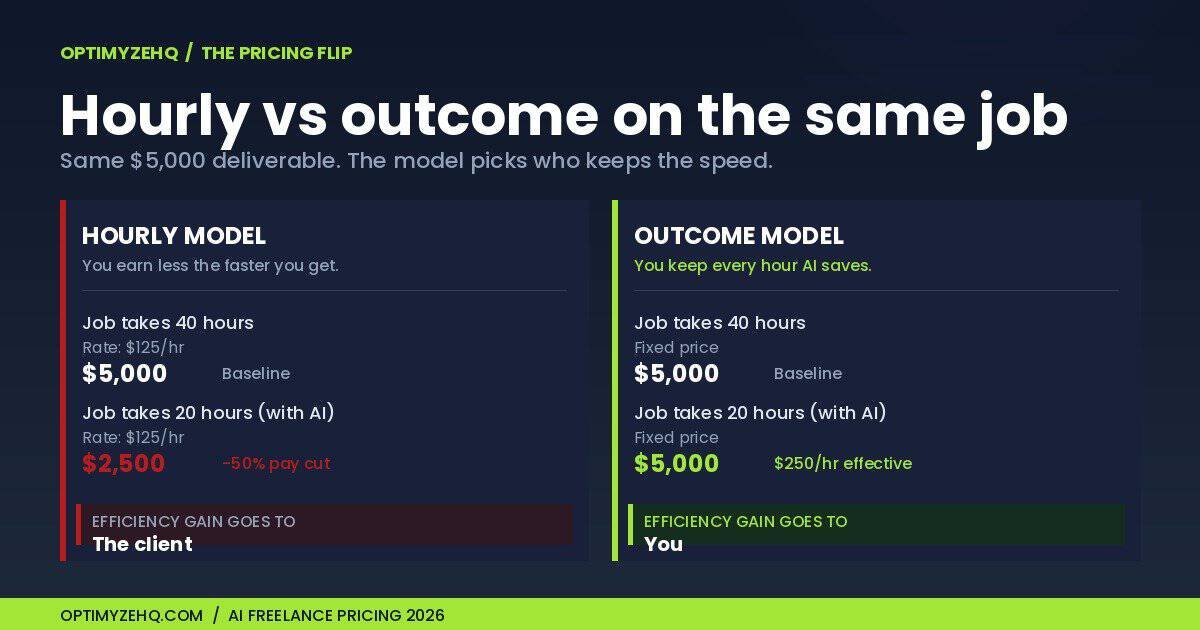
Say a client needs a launch email sequence and the value of that sequence to their business is somewhere north of $5,000. You quote $5,000 for the sequence. If it takes you 40 hours, you earned $125 an hour. If your system gets it done in 20, you earned $250 an hour for delivering the exact same result. The client got what they paid for. The efficiency gain is yours, because you took the risk on the fixed price and you own the upside of being good at it. That is the entire mechanism. Alan Weiss and Blair Enns have written entire books on it, and it reduces to one sentence: never quote a number until you and the client have agreed on what the result is worth, and never quote it per hour.
This is also why the deliverable you price has to be a real outcome, not a word count. “Twelve blog posts” is a commodity. “A quarter of search-intent content that ranks for your ten priority terms” is an outcome. Same drafts underneath. Completely different conversation about money. If you want the mechanics of turning one piece of thinking into a quarter of deliverables, that is the entire premise of our guide to repurposing content with AI.
An AI freelance pricing framework for 2026
Here is a repeatable way to set a number on any AI-assisted content engagement without spiraling. Four steps, in order, every time.
- Name the outcome and its value. Not the task. The business result. “Email sequence” is a task. “Recover abandoned-cart revenue” is an outcome with a dollar figure attached. Ask the client what that figure is. If they can name it, you have your anchor. If they genuinely cannot, that is a signal this engagement is closer to the commodity floor than you want, and you price defensively or pass.
- Set a floor from real benchmarks, not vibes. Use the verified ranges below so you are never the cheapest person in the room by accident. These are floors, not targets.
- Price the outcome above the floor, as one number. One fixed fee for the result. No hourly breakdown on the invoice, ever, because the moment it appears the client reverse-engineers your speed and you are back in the trap.
- Protect the margin with a delivery split. This is where AI earns its keep without eating your rate.
| Deliverable | Verified 2026 floor | Source / note |
|---|---|---|
| Blog / article writing | $0.25 to $0.40 per word | EFA 2026 Rate Chart, 1,100+ members |
| Single email (experienced tier) | $150 to $500+ per email | Price the email, not the hour |
| Full launch email sequence | $1,000 to $5,000+ as a unit | Never per-email math on a sequence |
| Conversion landing page | $500 to low thousands | Specialist tier runs well past this |
| Social caption (per post) | $1 to $10 | Strategic packages priced as retainers, not per caption |
Step 4 is the one that protects your money. Freelance coach Zach Swinehart adapted what he calls the 10-80-10 rule for AI work, a framework he credits to Dan Martell and which traces back to John Maxwell’s writing on delegation. You own the first 10%: the strategy, the brief, the angle. You hand the middle 80% to AI: the drafting, the variations, the first pass. You own the last 10%: the judgment, the edit, the thing that makes it yours and makes it work. The client is paying for your two 10%s. The 80% is how you protect the margin, not how you justify a discount.
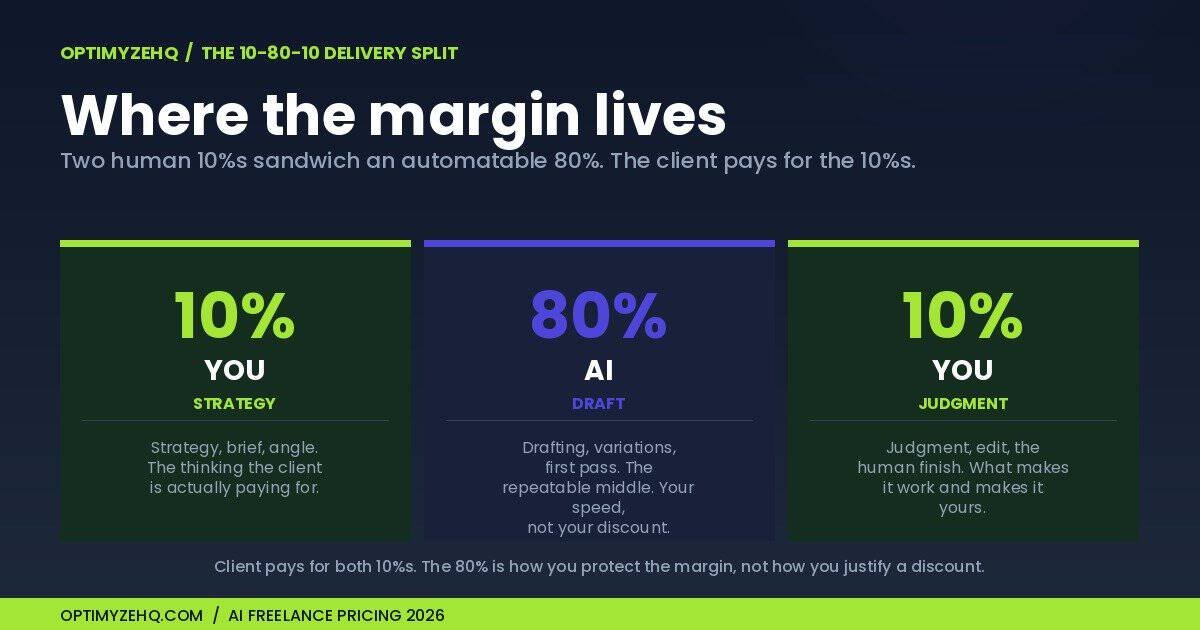
This framework only holds up if step 4 is a real system and not you improvising in a chat window every morning. The difference between a margin and a treadmill is whether the 80% runs the same way every time. That repeatable middle layer is exactly what a no-code AI content pipeline is for, and it is the difference between charging for an outcome and hoping you can deliver it profitably.
Your margin is a line item, not magic
One honest note before the pricing high turns into a hangover. The margin in this model is real, but it is not free. There is a cost stack, and you should know it cold before you quote.
A capable model subscription is on the order of $20 a month. An automation layer to run the repeatable middle, something like Make.com’s Core plan, is around $9 a month billed annually at current pricing. And the real cost, the one people forget, is your own time on the first and last 10%. That is not overhead. That is the product. The point of naming the stack is that it is small and fixed, which is exactly why a fixed outcome price works: your costs do not scale with the client’s, so the gap between your price and your cost is structurally yours to keep. If you are still deciding which automation layer to build that middle on, we compared the realistic options in Make.com vs n8n vs Zapier for solo creators.
What this isn’t
If this guide ended at “price the outcome and raise your rates,” it would be lying to you by omission. Here is the part most pricing advice skips.
Going premium is not a force field. Remember the “average” caveat from the Organization Science study earlier. When the researchers looked closer, they did not find that being a high-quality, higher-priced freelancer protected people from the post-ChatGPT hit. If anything, the evidence pointed the other way. The squeeze reached up. And on the buyer side, Ramp’s economics data shows the share of company spending going to freelance marketplaces fell roughly 79% between late 2021 and late 2025. That is not clients re-pricing freelancers. That is clients leaving the category. A pricing framework does not fix demand that is walking out the door.
So be honest about where “price the outcome” fails. It fails on pure-commodity output that any tool can produce in one prompt. It fails on transactional one-offs with no relationship and no measurable result to anchor a value conversation. It fails when the client treats AI as the baseline and you as cleanup labor, because then you are negotiating from inside the commodity floor, not above it. If what you sell is words by the pound, no framework on this page saves you. The work itself has to change first. The pricing only protects work that was already worth protecting.
What to actually say to the client
Back to that email. Here is the answer that holds, in plain language you can adapt.
When a client asks why it costs the same if AI did the work: “AI writes the draft. It does not decide what the piece is for, whether it is true, whether it sounds like you, or whether it does the job. You are paying for the judgment around the draft, not the keystrokes in it. That part got more valuable this year, not less.” You are not bluffing. HubSpot’s 2026 marketing data found only about 7% of marketers publish AI content without editing it. Everyone in the room already knows the draft is not the deliverable. You are just the one saying it out loud.
And when you raise a rate, keep it short and unapologetic: “My rate for this kind of work is now X. It reflects the results the current process delivers, not the time it takes. I’d love to keep working together at that number.” No essay. No defense. The confidence is the argument.
You don’t need more hours. You need a repeatable outcome.
The freelancers who lose this decade are not the ones who use AI. They are the ones who used AI to work faster, then handed the entire gain back to clients in the form of lower prices, and called the trap “staying competitive.” The ones who win priced the outcome, protected the margin with a real system, and stopped selling time that was never the point. That, in one sentence, is what good AI freelance pricing in 2026 actually looks like.
That system is the hard part, and it is exactly what we built the Creator Content Engine to be: the repeatable middle layer that turns “I can produce this fast” into “I can charge for this outcome and deliver it the same way every time.” If you want to start smaller and see how the pieces fit before anything else, grab the free starter kit and build the first piece this week.
Related: the prompting system that makes it possible to let AI handle most of the work.
Protect the hours you price: the pillar on client management for freelancers maps the five-stage system that keeps admin from eating your margin.