
The Voice DNA framework: 60 minutes of writing-about-yourself to make Claude actually sound like you
To make Claude sound like you, you do not need a better model. You need 60 minutes of writing about yourself, once.
The first 14 drafts my pipeline generated sounded like Claude doing a TED Talk impression of me. Every sentence had a tasteful em-dash. Every paragraph leaned on words I never use. None of them sounded like anything I’d post. Then I spent that 60 minutes writing about myself. The next 5 drafts read like I wrote them on a tired Tuesday.
That hour of work is what this post is about.
The actual problem with AI-generated content
The story most people tell about AI is that the models cannot do voice. That is not true. Claude Sonnet 4.6 and Opus 4.7 can sustain a specific voice across a full long-form draft if you give them something specific to hold. The problem is that almost nobody does. If you want to make Claude sound like you, the problem is not the model. It is the prompt.
What most people give Claude is one of two things.
The first is an adjective dump. “Write in a friendly, conversational, professional tone.” Claude has seen those words in a trillion documents from a trillion writers. They mean nothing about you. The output is the statistical average of every “friendly conversational professional” piece ever published. That is why it sounds like a press release.
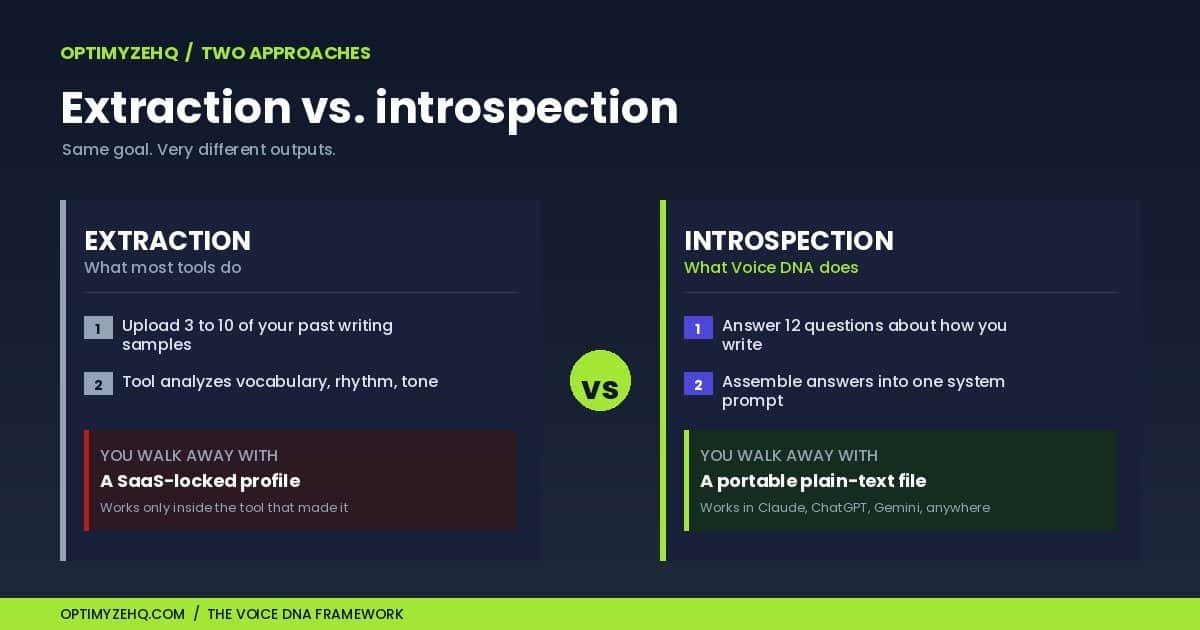
The second thing people try is sample uploads. Paste 5 of your old LinkedIn posts. Ask Claude to “analyze and replicate.” This is closer to right but still wrong. Your old posts capture what you wrote then, not what you would write now. They capture every compromise, every audience-aware softening, every word you used because the draft was due in 20 minutes. A model that pattern-matches against those samples does not replicate your voice. It replicates the median version of your past self.
There is a third method that beats both. It does not extract anything from your past writing. You do the work yourself, in your own words, for 60 minutes.
Introspection beats extraction
The mental shift is small but it matters. Stop trying to get an AI to figure out your voice from samples. Sit down and explain your voice to it.
Already have a back catalog you are proud of? Extraction can work too, as long as you curate. The companion to this guide, Train AI in Your Brand Voice, feeds the model a few of your best published pieces and builds the same kind of reusable Voice Profile from the writing you have already done.
This is how a new editor learns your voice when you hire one. They do not read your last 50 posts and reverse-engineer a style guide. They ask you a list of questions about how you write and who you write for. After an hour of you talking and them taking notes, they have what they need.
The Voice DNA framework is that same hour, but you write the answers down once and feed them to Claude forever. The output is a paragraph of plain English that lives in a single block of text. You can read it. You can edit it. You can paste it into Claude, ChatGPT, or Gemini and the next draft will read differently. No third-party SaaS. No upload. No analysis you cannot inspect.
A few products in this space already offer something interview-shaped, including one that walks you through a guided 10-minute Q&A. The difference is what you walk away with. Those tools keep your voice profile inside their platform, behind a subscription, powering only their own AI agents. The Voice DNA framework hands you a plain-text document. You own it. You paste it wherever. Portability is the point.
| Approach | What you upload | What it produces | Where it lives |
|---|---|---|---|
| Sample-based extraction | 3 to 10 past writing samples | A profile inside the tool | The tool’s platform |
| Guided interview SaaS | A 10-minute Q&A in their platform | A profile powering their own AI agents | The tool’s platform |
| Voice DNA framework | Nothing. You write the answers. | One plain-text file you own | Anywhere you keep notes |
A quick note on the name. “Voice DNA” is a term currently used by several products in the AI-writing space. IdeasOut markets a Voice DNA tool with a common-law ™. Smart Chimp has a pending USPTO application for the longer mark “Voice DNA for Attorneys.” Neither holds a registered federal trademark on the bare phrase. The OptimyzeHQ framework is not affiliated with either and is not a competing product. It is a writing exercise. The exercise produces a document. The document goes into whichever AI you already use.
The 12 questions, grouped into three tiers
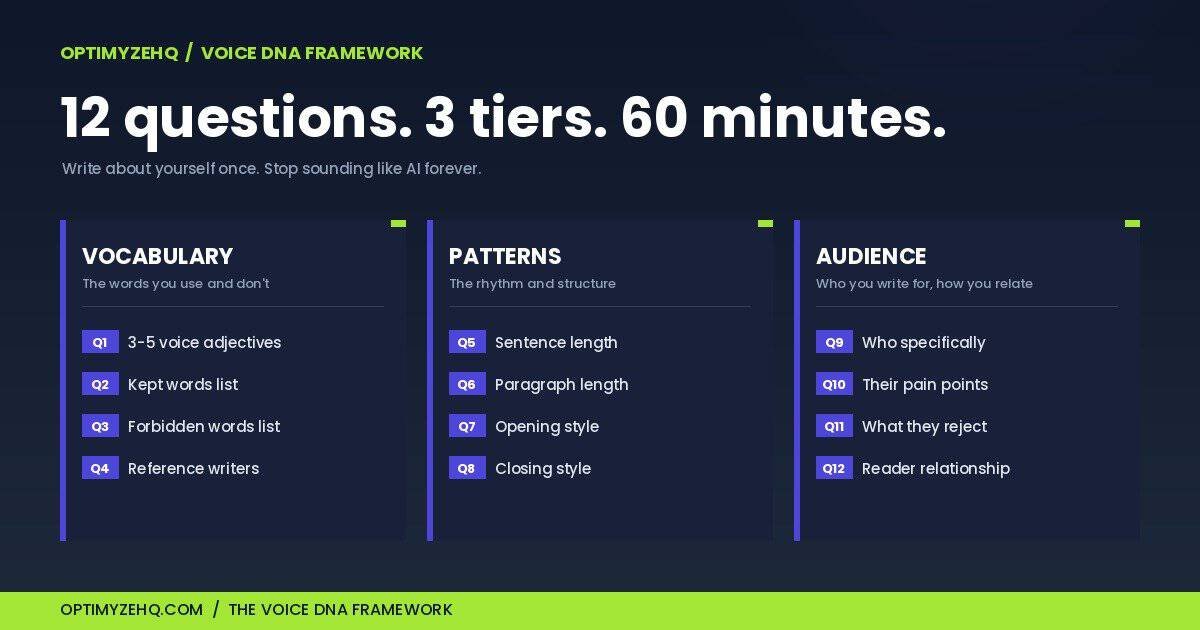
The framework has 12 questions. They split into three tiers: vocabulary, patterns, audience. Each tier shapes a different part of how Claude writes for you.
You answer all 12 in one sitting. Most people finish in 45 to 75 minutes. The longer it takes, the better the questions are working, because the slow ones are the ones forcing you to articulate something you have never had to put into words.
Tier 1: Vocabulary (the words you use and do not)
This is the loudest signal. Vocabulary is what makes a reader say “this sounds like Gilles” or “this sounds like Anne Helen Petersen” before they have parsed a single sentence.
Q1. Three to five adjectives that describe your voice.
Not adjectives for your brand. Adjectives for how you actually write. Mine are direct, practical, no-fluff, empowering, slightly technical. “Friendly” and “professional” do not appear. Those adjectives apply to every business in the world.
Q2. Five to fifteen words and phrases that signal it is you.
These are your kept words. The workflow, system, ship, repurpose, pipeline of your prose. The phrases that show up in your real writing because they are how you actually think. Read your last 5 drafts and circle the ones that are not generic. That is your starter list.
Q3. Five to fifteen words and phrases you never use.
Your forbidden words. Mine include leverage, utilize, synergy, ninja, rockstar, in today’s fast-paced world. The kept list signals authorship. The forbidden list filters out AI slop. Both are necessary.
Q4. One to three reference writers whose cadence yours resembles.
Mine are Patio11 for cadence, Paul Graham for clarity, Anne Helen Petersen for specificity. When Claude has 3 named reference points, it has something concrete to anchor to when your other answers are ambiguous. Pick writers whose work you can point to with a URL.
Tier 2: Patterns (the rhythm and structure)
Word-level signal gets you 60 percent of the way there. The other 40 is rhythm. Two writers using the same words sound different because their sentences breathe at different speeds.
Q5. Target sentence length: short, medium, or mixed.
Short means under 12 words on average. Medium means 12 to 20. Mixed means deliberate variation. Read a paragraph of yours aloud. Where do you breathe? If you are me, you breathe a lot. Mixed.
Q6. Paragraph length: tight, standard, or generous.
Tight is 1 to 2 sentences per paragraph. Generous is 5 or more. Mine is tight, because the audience reads on phones. Yours depends on where your readers are.
Q7. How you open a piece.
Specific number, contrarian claim, personal anecdote, question, vivid scenario. Pick one as your default. Mine is specific number or contrarian claim. This single answer kills 80 percent of the “In today’s rapidly evolving landscape” intros Claude wants to write.
Q8. How you close a piece.
CTA to a resource, question back to the reader, single decisive line, personal sign-off. Pick one. Mine is CTA to a specific resource, with a hard rule that the final line lands on its own and never starts with “In conclusion.”
Tier 3: Audience (who you write for and how you relate to them)
Voice without an audience is performance. Voice with an audience is communication. The audience tier is where most extraction-based approaches fall down, because your past writing does not tell Claude who you are writing for. You do.
Q9. Who specifically your audience is.
Not “creators.” Not “professionals.” Mine is solo creators and freelancers earning fifty thousand to two hundred thousand dollars a year who are stretched thin and want practical AI workflows, not hype. The more concrete, the better Claude can calibrate examples and asides.
Q10. Two or three specific pains your audience has.
For mine: rewriting the same idea for 5 platforms, tool overwhelm, setup complexity that kills good intentions. These are the things the reader is hoping each piece will address. Naming them lets Claude weave them in naturally instead of writing around them.
Q11. What content your audience actively rejects.
AI-as-magic claims, passive-income gurus, productivity hacks without context, jargon-heavy thought leadership. This is the negative space. When Claude knows what the audience resents, it stops generating it.
Q12. Your relationship to the reader.
Peer-to-peer, expert-to-learner, friend-to-friend, mentor-to-mentee, coach-to-athlete. Mine is knowledgeable friend. This single answer changes whether Claude writes “you should” or “I have found this works.”
That is the whole framework. Twelve answers, in your own words, in one sitting.
How to put this into Claude (and any other model)
Once you have your 12 answers, the easy part is assembly. Paste them into a single system prompt. In skeleton form, it looks like this:
You are a writing assistant for {name}, a {role}.
Audience: {Q9}. They care about {Q10}. They reject {Q11}.
Voice: {Q1}, channeling cadence of {Q4}.
Use these words freely: {Q2}.
Never use these words: {Q3}.
Sentence length: {Q5}. Paragraph length: {Q6}.
Open with: {Q7}. Close with: {Q8}.
Relationship to reader: {Q12}.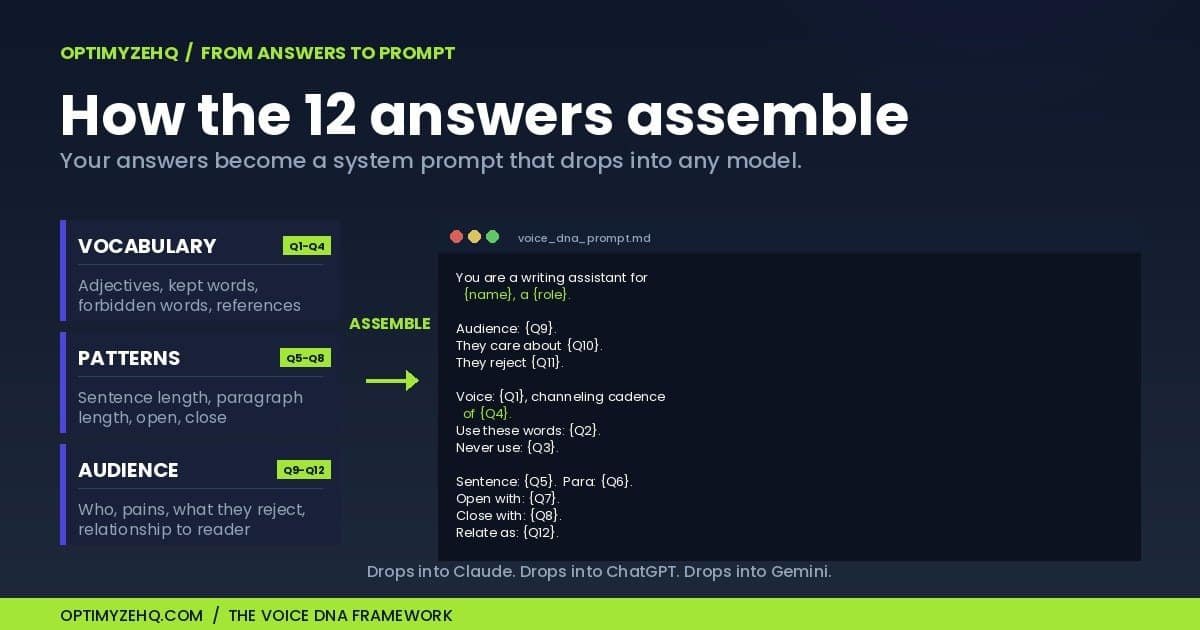
Drop that prompt into Claude.ai’s custom instructions, or into a Claude Project as a knowledge file, or into the system prompt field of any API call. The same paragraph works in ChatGPT, Gemini, and any other model that accepts a system prompt. There is nothing model-specific about it. The answers are about you, not about the AI.
One practical note about cost. A fleshed-out Voice DNA prompt runs about 1,200 tokens. That sounds expensive to paste on every API call. It is not, because Anthropic’s prompt caching applies on the second run and after.
The mechanics matter. A cache write costs 1.25 times the input token rate for the 5-minute cache, or 2 times for the 1-hour cache. A cache read costs 0.1 times. On Claude.ai and inside Claude Projects, caching engages automatically. If you are calling the API directly, you need to add a cache_control breakpoint on the system prompt block, and the cached prefix needs to be at least 1,024 tokens on Sonnet 4.6 or Opus 4.7. At 1,200 tokens, the Voice DNA prompt clears that floor with about 175 tokens of headroom.
Whether the savings show up on your bill depends on volume. For a creator running 5 platform drafts a week off one pillar piece, the dollar impact is pennies a month. At Sonnet 4.6 pricing of 3 dollars per million input tokens, a 1,200-token cached prompt across 5 weekly drafts costs under a dollar a year either way. The savings start to bite when the cached prefix grows past 10,000 tokens, or when the cadence climbs into agency territory. Anthropic’s published framing is “up to 90 percent cost savings,” and that ratio holds across the range. The dollars are yours to compute against your own usage.
The prompt being long is a feature, not a problem, as long as you stop editing it.
A working version of this exact system prompt lives in the free starter kit. It is a Notion template with the 12 questions and a fill-in-the-blank prompt skeleton. You answer once, paste once, and every draft Claude generates inherits your voice automatically.
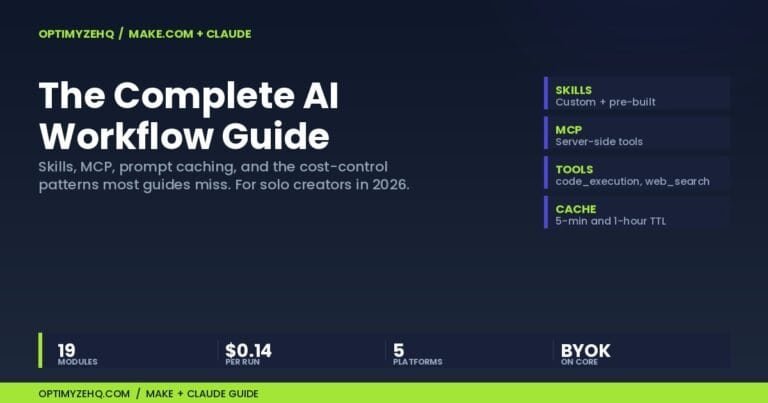
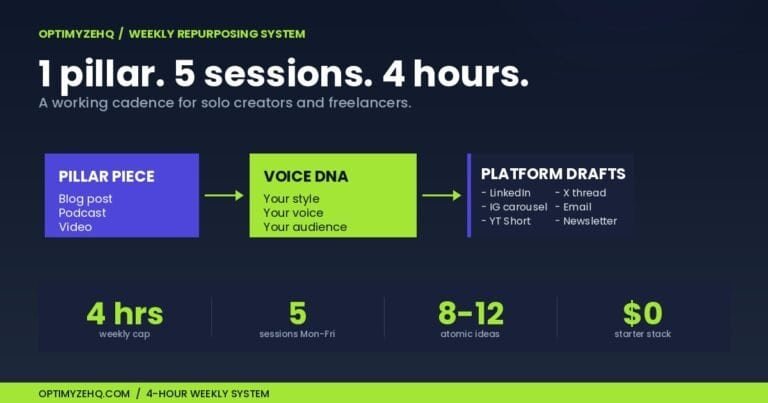
If you would rather skip the assembly and have the prompt drive an end-to-end pipeline that repurposes one pillar piece into 5 platform drafts, that is the automated version, and it is the same framework wired into a 19-module Make scenario.
What this does not fix
Voice DNA fixes voice. It does not fix substance. If your pillar piece is a generic AI-as-magic ramble, the platform drafts will sound exactly like you wrote a generic AI-as-magic ramble. Garbage in, voice-true garbage out. The framework is a voice filter, not a content quality filter.
It also does not fix the em-dash problem on its own. Claude has a strong learned habit of reaching for em-dashes when constructing parallel ideas. A prompt alone cannot suppress this reliably. Practitioners testing single-line bans on Claude report 90 to 95 percent compliance, not 100. I learned that the hard way when I launched Creator Content Engine. The fix that worked was a layered defense: prompt-level instruction, an editor pass (a second Claude call that scrubs the draft for AI tells), and a final code-level replace that strips any residual en-dash or arrow. If your stack is one Claude chat window, your Voice DNA prompt should include the explicit “zero em-dashes, replace with period or comma” rule, but accept that one will slip through every few drafts and you will catch it in proofreading.
It also does not fix prompts where the user message overrides your voice. If you ask Claude for “a corporate-style memo,” Claude will write a corporate-style memo. The system prompt sets the floor, not a ceiling that nothing else can break.
And it does not replace the human review pass. The framework gets you from “this sounds like generic AI” to “this sounds like a first draft I would have written.” Reviewing your own first drafts is still part of the job. AI takes the cold-start friction out. It does not take the editorial judgment out.
One more honesty pass. The first version of your Voice DNA will be wrong. My first Q3 forbidden-words list had 5 entries. By the third iteration it had 18, after I kept noticing Claude reaching for “seamless,” “robust,” “transformative,” and “navigate” in the figurative sense. Each missed slop word added itself to the list as I caught it in proofreading. Plan to iterate. The framework is not the document you write in hour one. It is the document you have after three or four passes, each one informed by a draft Claude produced that you cleaned up.
The framework also assumes you have something to introspect on. If you have never written anything in your own voice, you cannot answer questions about it. The fix for that is not a better prompt. It is writing 5 or 10 pieces in plain English, fast, before sitting down with the questionnaire. Voice DNA captures a voice. It does not generate one.
Two paths from here
Two paths from here, depending on how much friction you want.
Path one is do it yourself. Open a blank Notion page, paste the 12 questions from above, answer them, assemble the prompt yourself, drop it into Claude. Total cost: an hour of your time. The free starter kit has the exact template if you want a head start, including the system prompt skeleton ready to paste.
Path two is skip the assembly. Run a pillar piece through a no-code AI content pipeline that does the prompt construction, the 5-platform repurposing, the editor pass, and the dash stripping in one click. That is the automated version, Creator Content Engine. It is the productized version of every lesson in this post and the post about what to charge when AI does most of the work.
Either way, the framework is the same. The work is writing about yourself for an hour. Once. After that, the AI does its job. To make Claude sound like you, that is the whole job.
Related: Voice DNA is one piece of the prompting system behind every automation I sell.
Zoom out: the Voice DNA file is the voice layer of a complete AI content system. The other four stages are in the full architecture guide.
Your voice file, beyond content: status updates and client emails use the same tone notes. The client management for freelancers pillar shows where they plug in.