
How I Build a 90-Day Content Plan in One Afternoon
The 25-article roadmap this blog runs on came out of one planning session. The five pillars at the center of it are live as I write this, every one published against a keyword, a date, and a brief that existed before the draft did, and the fourteen posts that predated the plan now slot in as spokes around them. The session that produced the map took one afternoon.
Before that, my planning system was a Sunday-night scramble: a notes app full of orphaned ideas, a vague sense that I should publish more, and a blog that posted whenever guilt won. This piece is the exact method that replaced it, the one I now use to build a 90-day content plan in a single sitting.
It is written for solo operators who publish, or want to publish, one or two pieces a week. If you run a content team with approval workflows, this will feel too small for you, on purpose.
What Is a 90-Day Content Plan?
A 90-day content plan is one quarter of content mapped before any of it is written: a small set of pillar topics, the spoke pieces that support each one, and a calendar entry for every piece carrying its keyword, search intent, publish date, and status. It is the difference between deciding what to write once per quarter and re-deciding it every Sunday night.
Why 90 days and not a year? Because for one person, a year of detailed planning is fiction: tools change, offers change, you change. Why not a month? Because pillar content compounds through internal links, and a month is not enough runway to build a cluster. A quarter is long enough for the structure to pay off and short enough that the plan stays honest. Call it a quarterly content calendar with opinions.
One scope note: a roadmap can be bigger than a quarter. Mine runs 25 articles across more than one; the 90-day calendar holds whichever slice ships next, about thirteen weeks of slots.
Pillars First, Then Spokes
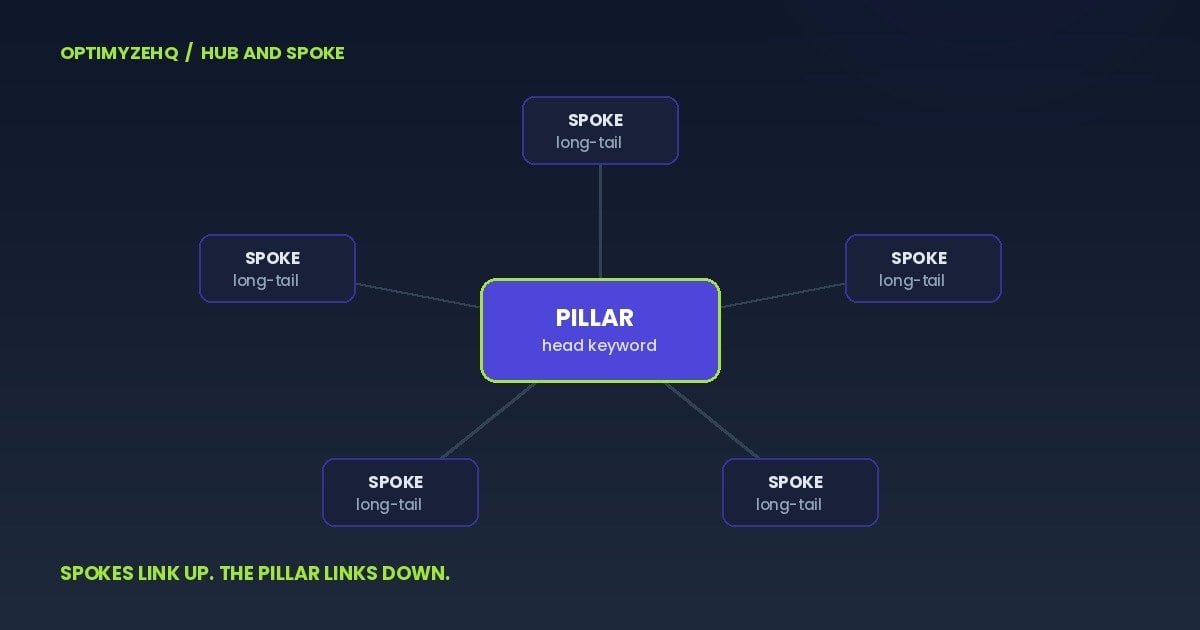
Two words to gloss before the method, because the whole plan hangs on them. A pillar is a broad piece on a topic you want to be known for, built around a head keyword: a broader, usually more competitive phrase like “client management for freelancers.” A spoke is a narrower piece answering one specific question inside that topic, built around a long-tail keyword: a longer, more specific phrase a real person types with one precise question in mind. Some of those questions are informational; some sit close to a purchase. Spokes link up to their pillar, the pillar links down to its spokes, and that hub-and-spoke shape helps readers and search engines understand how the pieces relate, while giving every article natural internal links.
Here is the real map this blog runs on, pillars and head keywords exactly as they sit in my planner today:
| Pillar | Head keyword | What it feeds |
|---|---|---|
| Master hub: AI workflows | ai workflows for solopreneurs | Everything; it links down to the four clusters |
| Automation tools and stack | make.com for beginners | Creator Content Engine and Client Pipeline Engine |
| Claude AI workflows | claude ai for solopreneurs | Every product |
| AI content and newsletters | ai content system | Creator Content Engine and Newsletter Engine |
| Client ops and back office | client management for freelancers | Client Pipeline Engine |
Five pillars is my ceiling as one person. Three is a fine floor. More than five and the spokes thin out, the clusters never finish, and the map stops being a plan and becomes a wish list.
Here is one of those clusters opened up, exactly as it sits in the calendar: the pillar, its live spokes, and the next planned piece.
| Piece | Type | Keyword | Status | Date |
|---|---|---|---|---|
| How to Build an AI Content System That Doesn’t Sound Like AI | Pillar | ai content system | Published | June 11, 2026 |
| How to Repurpose Content with AI | Spoke | how to repurpose content with ai | Published | April 27, 2026 |
| AI Newsletter Automation with Claude and Make | Spoke | ai newsletter automation | Published | May 23, 2026 |
| CMS Publishing Automation for Creators | Spoke | Set at briefing | Planned | Mid-July 2026 |
Notice that two of those spokes predate their pillar by weeks. That is not a scheduling failure; it is the retrofit case. If you already publish, your existing posts become spokes retroactively: assign each one to a pillar, add the up-link, and let the new pillar link down to them. Fourteen of this blog’s posts entered the plan exactly that way. The pillars-first rule, coming up in Phase 3, applies to clusters you build from scratch.
The Afternoon, Phase by Phase
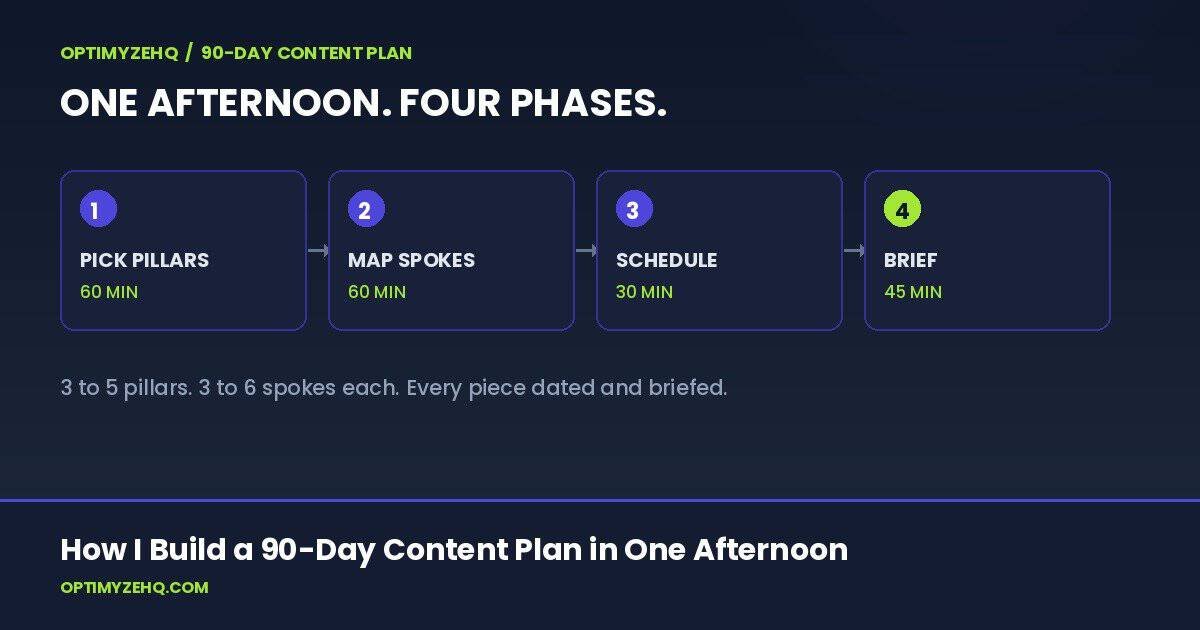
The method is four phases run back to back. The times below are honest estimates from my own first pass; a quarterly refresh runs faster because the pillars rarely change.
| Phase | Time | What you produce |
|---|---|---|
| 1. Pick your pillars | About 60 minutes | 3 to 5 pillars, one head keyword each, and the offer each one feeds |
| 2. Map the spokes | About 60 minutes | 3 to 6 spokes per pillar, each with a long-tail keyword and a search intent |
| 3. Schedule the quarter | About 30 minutes | A target date for every piece, pillars first |
| 4. Brief the first two weeks | About 45 minutes | A filled brief for each of the next pieces |
The first pass totals about 3 hours and 15 minutes. Every quarter after that runs shorter, because Phase 1 mostly survives.
Phase 1 is the strategic hour, and it starts with offers, not topics. For each thing you sell, or want to sell, ask: what would someone need to believe, and to know, before buying this? The topics that answer that question are your pillars. Write each one down with a single head keyword and the offer it feeds. If a pillar feeds nothing, it is a hobby; keep it only if you can say so out loud and mean it.
Phase 2 is volume. For each pillar, list the specific questions your reader actually types: the comparisons, the how-tos, the “is this worth it” doubts. Three to six per pillar. Give each one a long-tail keyword and label the search intent: informational means the reader wants to learn, commercial means the reader is comparing before a purchase. The label matters later, because an informational piece that pitches hard fails, and a commercial piece that never reaches a verdict also fails. Before anything enters the calendar, run a five-minute validation pass: search each phrase and look at what ranks. Tutorials and listicles mean the intent is informational; comparisons and landing pages mean commercial. Drop any idea whose results answer a different question than yours, and merge any two ideas chasing the same one.
Phase 3 is the calendar pass, and it has one rule that matters more than the rest: schedule pillars first. Spokes need a hub to link up to, so a spoke published before its pillar launches half-connected. Then pick a cadence you can hold. One to two pieces a week, sustained, beats four pieces in week one and silence after. I schedule against the floor of what a bad week allows, not the ceiling of a good one.
Phase 4 is what makes the plan survive contact with Monday. For the first two weeks of pieces, write the brief now: working title, the one reader it serves, the keyword and intent, an H2-level outline, the internal links up and down, the sources to verify, and what the piece will not cover. A filled brief is the difference between starting warm and staring at a blank page. Two weeks ahead is enough; briefing the whole quarter up front wastes effort on pieces the quarter will reshape.
The 15-Minute Weekly Loop
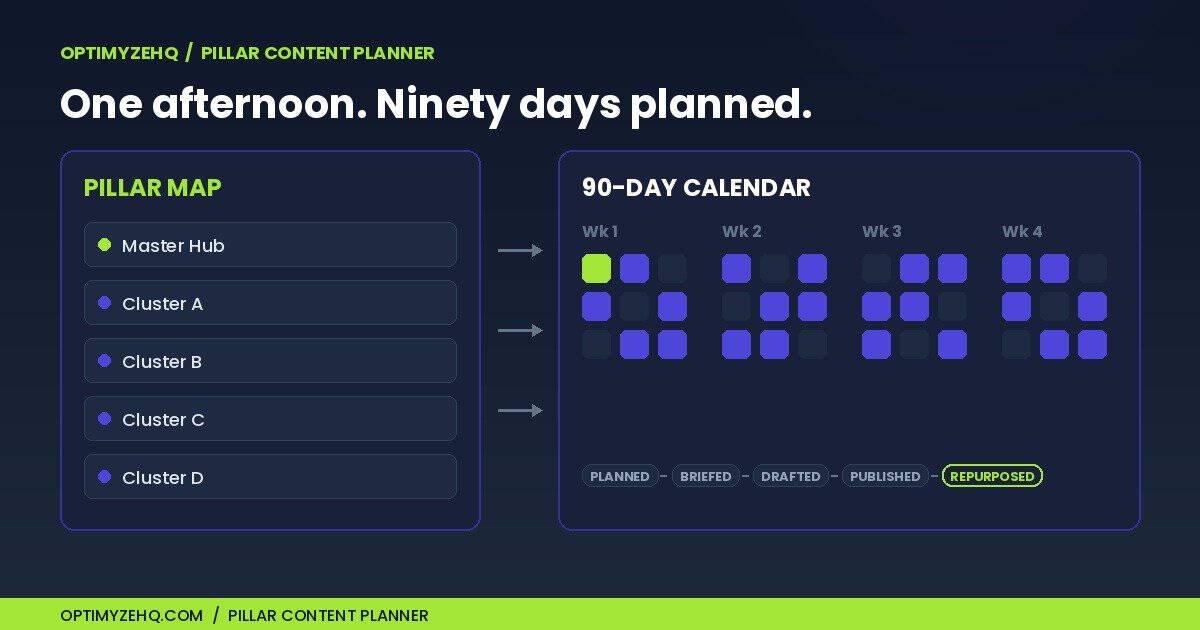
The afternoon builds the plan; a short weekly loop keeps it true. Every piece in my calendar carries one of five statuses: Planned, Briefed, Drafted, Published, Repurposed. Once a week, fifteen minutes: open the week’s pieces, advance the statuses that moved, and brief the next piece so drafting never starts cold.
The mechanism holding this together is unglamorous: every calendar entry is related to the pillar it supports, so the hub-and-spoke structure stays visible in the plan itself instead of living in my head. When a cluster looks thin, I can see it. When a pillar has no spokes scheduled, the gap is a blank column, not a vague feeling.
That last status, Repurposed, is the stage most planners skip. A published pillar is not a finished asset; it is raw material for the social posts and newsletter issues that actually get seen. That is its own method, and I have written about it in how to repurpose content with AI. In my own stack, finished pillars feed the Creator Content Engine, a paid repurposing system I sell, but the status works the same if your repurposing is an hour with a blank document.
What This Method Isn’t
It is not keyword research. The afternoon assumes you can name the phrases your reader types. Tools that estimate search volume can sharpen the list, but the method works from judgment and a search box alone, the way this blog’s plan did.
It is not AI writing. Nothing here drafts a word for you. The plan tells you what to write and why; the writing is still the work.
It is not automation. There is no scenario to configure and nothing runs on a schedule. It is a planning method, and the smallest version of it runs on paper.
Run It on Paper, or Run the Pre-Built Version
Everything above works with a paper notebook or a blank page in Notion: two lists, a date column, a status column, and the discipline of the weekly loop.
If you would rather start from a working system, the Pillar Content Planner, a $47 Notion template I built (June 2026 pricing), is this exact afternoon pre-built: the pillar map and 90-day calendar as connected databases, the nine-section brief template, the quarterly checklist, and my complete real plan, including the pillar map and the cluster opened up above, pre-loaded as a worked example you clear when ready. It removes the setup, not the thinking; the method above is the whole method.
Either way, the afternoon is the asset. And if you want to see what a finished cluster looks like from the inside, the pillar this piece belongs to is how to build an AI content system that doesn’t sound like AI.
FAQ: Planning 90 Days of Content
What is a 90-day content plan?
A 90-day content plan is one quarter of content mapped before writing begins: 3 to 5 pillar topics, 3 to 6 supporting spoke pieces per pillar, and a dated calendar entry for every piece with its keyword, search intent, and status.
How long does it take to plan 90 days of content?
About one afternoon for a first pass: roughly 60 minutes to pick pillars, 60 to map spokes, 30 to schedule the quarter, and 45 to brief the first two weeks. A quarterly refresh runs faster because the pillars rarely change.
What happens when priorities change mid-quarter?
Change the calendar when an offer moves, a tool you cover materially changes, or a reader question exposes something more urgent. Do not change it because a new idea feels exciting on a Tuesday; new ideas go to the next quarter, where most of them stop being exciting.
Do I need special tools to plan 90 days of content?
No. The method runs on paper or a blank Notion page. A pre-built template saves the setup time, but the value of the plan is the structure, not the software.